Tuesday, 5 August 2014

USB dead-drops, physicality and secretly-sharing


When I saw Breaking Bad a while back, one of my favourite things about it was the physical details of how illicit activities can happen in plain sight without anyone noticing. One of those details was the dead-drop sequence where they moved small amounts of meth and money by having different people dropping and picking them up at obscure locations around Albuquerque, places where no one would ever check. 

Beyond the TV screen, dead-dropping is a technique that can be (and is) used in real life. Criminals, spies, ninjas and any other personnel of covert operations may be expected to make use of this practice every once in a while to transfer letters and packages. How many of these folks are active in this city?

Dead-drops are one example of the many alternative communication possibilities our urban spaces can offer. It signifies a hidden layer of communicative functions only available to those who know about it. There may possibly be infinite numbers of these layers that you don't know about. Given the way perception works, you can never know how much you don't know. Take the case of language. I don't know Morse code. How do I know if everyone around me are not discussing their murder schemes every time they blink their eyes? You never know with these ninjas. They can be anywhere, anyone, at any time.

Here is something I do know about. Aram Bartholl, a media artist, had taken up the dead-drop name for a project in which he installed USB flash drives in random locations in NYC in 2010. He literally sticked USB drives into brick walls and patched some cement around them to keep them intact. He called them USB dead-drops. These dead-drops are like the traditional ones described above except that they are digital. It is a digital communication network that is anonymous, locally-based and offline. If you know where one of them is, you can go there and upload data onto the drive and also download whatever data that's on it.

I think it's a pretty cool idea, many others thought so too, and since 2010 people around the globe had taken up the initiative to install USB dead-drops in their own cities. It's pretty easy to install one, and if you wish to you can submit its coordinates onto the map on deadrops.com. I have checked out some of these coordinates in Rotterdam, here are pictures of their current conditions.

On the Erasmusbrug

At Westplein

 
Witte de Withstraat

A part of the excitement in this initiative, for me, is its emphasis on physicality. It is intuitive for me to physically go somewhere and drop off or pick up a message. The travelling to that specific spot is a part of the communication, as is the location itself. While modern communication technologies had significantly cut down the time for messages to travel, it had also completely cut down actual physical travelling OF or FOR these messages, both of which could have carried a lot of extra meanings. By (re)-placing data in the real physical context, we re-include the spatial-locational element into communication. This is not unrelated to the oft foretold Internet of Things, but in the case of dead-drops, things are not connected via the Internet. Actually a dead-drop and your personal devices can only be connected by your movement between/to them. They are connected via you. It's the Internet that is You! (I'm sorry I'm pretty bad at coming up with theoretical catch-phrases)

--
You may have noticed from the pictures that some of these drops are broken. When you place anything in public you risk vandalism and natural wear. The other thing you risk is security. It's quite possible for an open USB drive to be infected with malware, which can then infect every device that comes into contact with it. This is a pretty serious problem and it is what stops many from connecting their devices to a dead-drop. There is a political discussion in this: can you trust an anonymous people to use a shared tool/property and not ruin it for each other? Instead of approaching it as a ethical-philosophical debate regarding Hobbesian social-contracts etc, a relatively easier way out is to solve these problems through design.

First off, to a limited extent, the problems cancel each other out. As per its current standing, I think USB dead-drops are more of an experiment/artistic-statement rather than an attempt to create a functional information infrastructure, and these guerilla data storage devices are not designed to last. They break pretty easily, and the short life-span of a drop may be a protection mechanism in itself. If a drop is new and fresh, it might not have caught any malware yet. If a drop is old, it's probably already broken anyways and will not be able to infect anything. This system doesn't guarantee security, it guarantees nothing but the fact that an infected drop will not serve to infect many more devices. This limits the scope of damage.

A security measure users could take is to actually keep the discreet location of a dead-drop a secret between a small group (i.e. not publish its coordinates on a website). If only trusted people will have access to a drop, you can then trust in these people's judgement and assume that only trusted devices will be connected to it, thus keeping it clean. This is a form of social security.

If we are to solve these problems through improving/changing the hardware, maybe wireless alternatives can also be a more costly option. Small servers can be placed in a secluded and protected environments, not (easily) physically reachable but can be connected to via wi-fi when you're in its proximity. You go to that pavilion in the park where you always meet up with your friend. You take out your phone, connect to this local network that only you know about, and download a new mini-video that he left for you there. By the time you are watching this video I would already be in Ireland, he said so in his webcam recording, I suppose this was an Irish goodbye. You delete that video from the local server and cry. Your friend was also your boyfriend but now it's complicated. The problem with this scenario is I can't really figure out a way to constantly supply power to that server. Only bring portable power supply to the server when someone wants to access it, maybe? In any case this server-approach loses some of the guerilla charm of USB dead-drops.

--
Since we're talking about charm, let's get back to dead-drops' social security tactic for a sec. I want to end this on a note about trust. Maybe one of the few people who use your drop will judge wrong one time and infect the drop. Maybe some of these people are malintentioned from the very start and planned to compromise your device. All of these are possible, but consider it is known that the NSA can alter hardwares for surveillance purposes as they leave the factory, consider that personnels like Edward Snowden were trusted with access to your emails, consider that just visiting FBI targeted websites puts the security of your machine at risk. I think it's reasonable to trust local people you know in your personal network, at least as much as you trust someone you've never met on the other side of the Internet, thus trusting a secret small-user-group dead-drop as much as you trust the Internet (if not more). And if a small group of intelligent people trust each other, they should be able to share a secret dead-drop for all kinds of purposes pretty successfully. Based on trust, it'll be a very communal kind of sharing, possibly ritualistic, possibly tribal.

Saturday, 5 July 2014

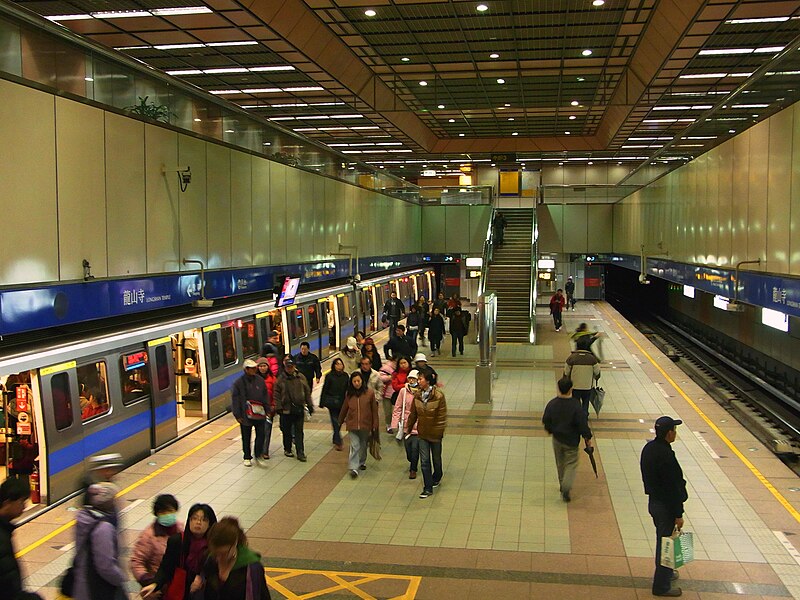
Not Rotterdam: The longest distance between two metro stations (Taipei)

wikipedia.com
I haven't been updating this Rotterdam blog because I haven't been in Rotterdam recently. Instead I'm in Taipei trying to look at as many things as possible. I grew up in TP and it's likely that on a subconscious level this city had curated many of my urban fetishes. Or, in the phrasing of an architecture book I flipped through in a bookstore today, Taipei had taught me my urban mother-tongue. I like car exhausts. I like messy street signs. I like natural colours situated in grey. I like cheap & efficient public transport. I like 24/7 food. I like busy but warm-hearted people. There is a lot to think about and it's taking me a while to figure out where to start.

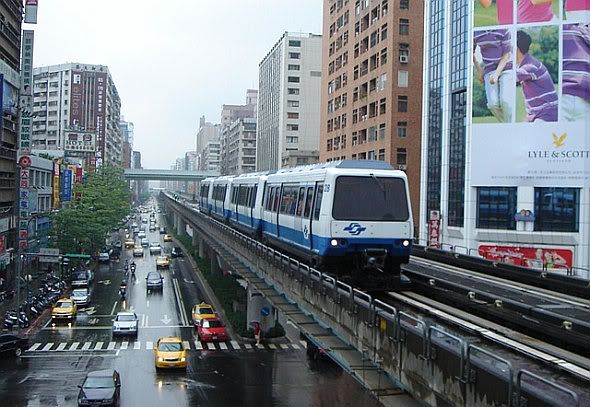
We can start with metros. It's a good place to start. My very first experience of metro travelling was with Taipei MRT and it's still my favourite metro system today. The Wenshan line is completely automated and runs on elevated rails through the city, it's almost like a theme-park scenic ride. The other lines are mostly underground, they are inviting and cozy and efficient and clean and are everything that metros should be.

eurotrib.com

A few weeks ago there was a metro tragedy in Taipei that shocked the city greatly. While travelling on a carriage between two stations, a mentally disturbed university student whipped out two knives and stabbed 28 people,  killing 4 of them. This kind of crazy slasher incident had never happened before in Taipei and many grew paranoid. After the attack, for a while the police assigned special-force operatives equipped with sub-machine-guns to patrol metro stations in order to scare off any similar attempts. A lot of the city's inhabitants felt that this was inappropriate and looked like a police state. If anything it only made the metros scarier.

The emotions had since settled down, the sub-machine-guns are removed and when I took the MRT today it wasn't very scary at all. Anyways I guess what matters the most for commuters is not how safe the metros actually are, but rather how safe they feel about it. 

--
When reading about the young attacker and his methodologies, a specific item drew my attention: He had allegedly observed the MRT system very thoroughly to select the time and place for his crime. The ride between Longshan Temple Station and Jiangzicui Station takes a total of 3 minute and 46 seconds, it's the longest time between any two consecutive MRT stations in Taipei, and this guy figured that between these two stations he has the longest window to stab the maximum amount of people on a moving train before they can get off the carriage. He did end up stabbing a high number of people, and for his purpose this was an effective plan. If he chose a random ride between two random stations, it is likely that his crime would have been of a smaller scale.

At the observation stage he had allegedly timed the metro ride between every MRT station with his wrist watch, to know exactly how long each ride would take. This sounds a lot like something I would do for this blog. Luckily I am not a psycho murderer and my observations do not serve any sinister end. If a psycho murderer does find this blog, however, and were to use my urban patterns to design a ritualistic murder spree in Rotterdam, there is little I can do about it. Urban observations consist of methodologies that produce data, which can then be used to to generate meanings that may in turn inspire further actions. Starting from the generation of meanings, the process gets dynamic and can possibly be volatile. Texts such as this one only offer potentials.

Rotterdam Beurs metro station
When I get back to Rotterdam by the end of the month I hope to also measure and record the time it takes between each metro station. I will then also find out which journey between two specific stations takes a longest time. The practical implications is that during this journey the metro carriage is its own world, for a minute or two segregated from any external authorities or control. It forms a temporary stand-alone space that can develop its own rules. The tragic murder of innocent people is one extreme development, but it is certainly not the only possible development. What else can people do with the metro's momentary social pocket-reality? Here are a few ideas:

1. Practice radical politics
-Leftist, rightist, anarchist, any
-Distribute slogans and pamphlets
-Start your own country, start your own non-country
-Run this (non)country for 2 minutes

(The Netherlands is pretty open with its freedom of speech, and people can often practice political communication without being censored. This is not the case in many countries, in which the metro pocket-reality is more relevant for political actions. In some countries advocating gay rights is considered to be radical politics. If I were a gay man who would like to kiss my boyfriend on the metro as a political statement, in a country where this is taboo, for example, I should rather do it between the two stations that have the longest metro ride between them so we can have the longest kiss.)

2. Practice radical cultist religions
-Evangelism
-Worship & rituals
-Being possessed by a spirit who will use your mouth to speak a prophecy. (S)He has over 2 minutes to do it!

3. Play very very loud music, play very very vulgar music
-"Abrasive", "annoying", "that's not music that's just noise" etc

4. Perform very very loud theatre, perform very very vulgar theatre
-I imagine some form of cabaret

5. Perform an actual orgy
-Variety of participants
-Different genders and sexual orientations

6. Consume drugs
-Alcohol: we already see this sometime
-Others

7. Violate copyright laws
-Screen a part of a movie
-Share other copy-righted arts for free

8. Advertise for cigarettes and other items that are not allowed to be advertised
-Advertise in purposely misleading fashions targeting children
-Subliminal messaging

9. Talk about my stupid poetry
-Usually no one can stand that sappy tripe, it's basically a crime in the regular social reality, but I imagine a setting in which I can indulge myself the poet's sentiments for two minutes. At the beginning of June I was writing a pathetic song called Season Finale but then oh wait wait wait wrong blog again

10. Combine any 2 or more of the above

--
Some of these actions are not necessarily what I would like to see or what I would enjoy. I would be quite uncomfortable if someone is too drunk or too high on the metro, for example. I would also be uncomfortable if anyone practices hate-speech loudly on a metro carriage. The purpose of this blogpost is to point out that if one or more passengers plan to perform any of these actions on the metro, they can choose to do so between the two stations that have the the longest journey time, so as to perform the action for as long as possible before being forcibly stopped by law-enforcement personnels or any external actors (or before loosing the audience). Such is the possible implications of the time-span. Whether and how these actions would offend or disturb other passengers is a different discussion. Why do I smile if I see a gay couple lightly kiss on the metro, but would frown if I see a group of people having coked-up sex while worshipping an ancient fertility god? Does it make a difference whether these actions are performed on a moving metro carriage or any other public/private space?

For one thing, the actual performance of said coked-up sex on the metro would stimulate us to think about the issue. More possibly, just knowing that the specific metro journey takes a relatively long time can stimulate us to imagine said coked-up sex, or any other things we can do with this time. I have listed drastic options, but you can very much also do things like holding the hands of the person beside you through the longest metro ride.

--
Update: Since I've written this post I have travelled between Longshan Temple Station and Jiangzicui Station two times. Both times my friend timed the journey with a stopwatch and the travelling time is consistently 3 minutes 10 seconds. Maybe they have speeded up the ride? Maybe the news article was inaccurate? Maybe the murderer was too disturbed to measure correctly? Many maybes.
--
Update: In November 2014 I have found the two Rotterdam metro stations that has the longest distance in between.

Tuesday, 27 May 2014

Eiland van Briennenoord


This specific spot in the picture has an unique soundscape so outstanding that the sounds alone merit a visit. The A16 highway traffic and the howling underbridge-winds concoct a raw and hard-coming rumbling. The waves from the Maas break on the rivershore rocks and make for constant water splashes. When these sound sources layer up, if you close your eyes and retreat into an audio reality, it is not difficult to imagine a rainstorm taking place around you. This is a storm point, even on a fairly sunny day.

But then, if you're here at the right time, you will also notice the presence of a lively chirping from your local bird-friends, hanging around in the trees on your sides. This lightness dresses up the heavies, and together they satisfy both ends of a tonal spectrum. There is a deep moving force which overwhelms, but there is also this reminder of immediate lives that sing regardless. Buddy, it's like the truth of the universe or something. 

It may be difficult to believe that a soundscape as aesthetically complete as this one wasn't designed specifically to be so. Sometimes recorded music isn't even this good.  I don't know if they took these sounds into consideration when they built a concrete bridge over an island in the middle of the river. On one hand I would like to live in a world where people have the sense to intentionally create spectacular spaces like these. On the other hand I would also like to live in a world where spaces like these can come to be on their own.

Where is this specific space anyways? Remember in the previous post where I saw some trees in the river after I've crossed the bridge? I managed to walk to where the trees were. It turned out to be an island in the middle of the Nieuwe Maas called Eiland van Briennenoord. I guess I've seen it on the map, but I never expected it to surprise me in so many ways. I guess that's the definition of a surprise.

--


There's something cinematic about tall, grey concrete structures. Especially when you walk under them and realize how small you are in comparison.  You can see this place in a post-apocalyptic movie as a spot where future nomads would settle for a week. There's a lot of graffiti here which gives it an urban personality, even when it's a little far out from the city centre.

For more current information, I have heard about a presence of present-day urban nomads, namely the homeless folks that come here at night and hang around. Some might feel uncomfortable about that and wouldn't want to be here after a certain time. How you choose to feel about the situation and what you decide to do about it is an issue you have to resolve internally. According to numbers from 2006, there are 4000 homeless people in Rotterdam, and this was before the economic recession. I don't usually think about it much lest it keeps me awake at night, while I lay in my bed, under a roof. Anyways what matters is what needs to be done to help them and who is willing to contribute to these efforts. How I feel about it personally is of minor causal significance here except that it is difficult for me to summarise the issue in any short sentence. Here's more details on the Rotterdam government's homeless policies.

--


A discussion can be had about whether managed green spaces like this in an urban setting count as "nature". In my preferred definition, anything that people do and build is "natural", as people came to be and act they way they do "naturally" (i.e. we came from cave people to this urban civilization without any artificial third party involvement). As such, a man-made park is a piece of "nature" but then maybe so is a parking lot. There are plants and animals that are active in both environments.

Many plants and animals are active on the island. I've never gotten into identifying them but maybe I should. There are several different kinds of birds here, for instance, and it would be fun to know what species they are. But it is also fun to just look and listen. I think the walking ones are pheasants.

Starting every May and until sometime in the winter, they also place grote grazers on the island, namely Scottish Highland Cows. They are really chill (as long as you don't get too close or irritate them) (anyone who's chill is probably like that). You may find them hanging around the woods or strolling on the footpaths or taking a dip in the ponds. They have younger calves too. In my experience it is difficult to find a person who doesn't like these cows.

People also come to the island for angling. I feel neutral about angling. I eat fish. I don't eat cows. But hey this isn't chiefly a blogpost on how I manage my compassion and how that affects my life choices, maybe I'll stop now. I can write about these topics elsewhere like in these motivation letters I'm sending out 

--

We may identify the island's two specific connections to Rotterdam's urbanity, one historic and one visual. The historic one: in the 60s, Rotterdam built the first metro system in the Netherlands, with a metro line that went from Centraal Station to Zuidplein. After the Maastunnel, a second tunnel under the Maas had to be built for this metro, and most of that tunnel was built on the island before being lowered into the bottom of the river. It was 2 km of solid engineering feats, very much in character with this city. Some traces of the construction process are still left on the island.


The visual one doesn't need much explanation. Initially I planned to stand on the Van Briennenoordbrug to find a sweetspot for viewing the city's skyline. I didn't find it on the bridge but I have found it on the island that the bridge is named after. Come and see for yourself. The city looks pretty good from here.

A line of conclusion? I'm really busy now but hopefully as the summer hits I'll have time to come back here more often. City-dwellers like to talk about the search for an island of composure and retreat, in the sometime-stifling anxiety of urban life. People usually mean that metaphorically but this is literally that kind of island. Lately I've been feeling like I can use some composure and retreat but oh look we're back to my problems again.

Saturday, 5 April 2014

Crossing Van Brinnenoordbrug


I mostly operate on the north side of the Nieuwe Maas and for all the time I've spent in this great city much of the southern areas remained untrodden by my feet. I thought that's a huge shame and needed to be changed. When I look out from the Kralingse Zoom parking garage  roof I can see this bridge and I figured the city skyline would look pretty swell from that angle. I thought I would stand on the bridge and look at the city, and then walk across and take a look at what's on the other side.

The actual skyline-watching from Van Brinnenoordbrug didn't go as smoothly as I wished. The bridge is a part of the A16 highway and thus functions chiefly as a passing for vehicles. The only possible viewing position for pedestrians is from the bicycle path, and the bridge only has a bicycle path on its eastern side while the city-centre is at its west. When looking at the city from this path, highway cars run between you and the city and they distract your vision. Of course, this visual noise has its own raucous aesthetics and together with the audio traffic noises can put the viewing experience through an unique lens. However, on the bike path there were also bikes and mopeds constantly passing through, and the narrow lane does not allow for a comfortable standing space while the non-car traffic overtake you. Rightly so, too, as these paths were made for travelling and not for some free-standing weirdo urban-observer such as myself. But anyways these conditions had made the spot sub-optimum for seeing the city.

To be fair, there were some interesting sights to the east side of the bridge worthy of anyone's attention, and the bridge is still a cool place to be on. Sights like

water purification plant

office buildings Solaris

IHC Merwede Shipyard
--
After walking across, I wandered around for a while and decided to check out what it's like under the bridge. This turned out to be the onset of the day's most significant discovery.


These columns. They remind me of ancient temple stone colonnades, but are modern and concrete. Like their ancient counterparts, they serve both functional and symbolic roles. They uphold the Van Brinnenoordbrug, there is that, but in doing so they also uphold one of the busiest highways in the Netherlands. Columns like these are the foundations of a modern culture symbolised by a lot of cars. As we move into a post-modern culture and an information-based economy, the symbolic significance of highways is replaced by the internet, the information superhighway. Cars, in the context of this symbolic shift, are loud and heavy and physical and yesterday-nostalgic. Some might say these are all Rotterdam qualities and are integral to the city's personality. Here you can hear the sound of highway cars feed through a pretty effective acoustic space.


Amazing harbour-themed murals in the style of Delft Blauw, created by Ricardo van Zwol quite recently. Behind them there was a stretch of vegetation. At first I didn't know how to get to them because there was river water between us. I decided to find out how and eventually did. It's an actual island in the middle of the Nieuwe Maas called Eiland van Brinnenoord. I had no idea it was there. It deserves its own blogpost.

--
These pictures are okay but they don't illustrate the sheer size of the columns and their real immediate physical impact. You have to be here to feel it. Another thing that impressed me was the vast open area between them. Between each row of columns there is significant empty space, paved in the same kind of  red asphalt as they do for bicycle paths.

As they are positioned under a bridge, they should remain reasonably dry and usable even in rainy days. I get excited whenever I see any kind of public open space, and start imagining what they can be used for. These have such potentials. Street football? Skateboarders' meet-up trick-ups? Weekend battle-rap tournaments? Shadow-puppet improv-theatre at night? Anarcho-outsiders book market? Morning Taichi groups? The possibilities are endless. I looked around for clues of what people might do here. After some amateur forensics I found a collection of evidence:

Broken cider bottle

weed

used fireworks

skid-marks

I can use these components to construct a scene of suburban boyz' volatile chillage.  This process is, of course, not the perfect way of seeing the past because these are less reconstructions and more imaginations. To various extents, all studies of the past are like that (consider dinosaurs), but in this case there is a better method of research than looking at leftovers. I can, in theory, stay here until some of these people show up and chat them up. I'm probably not going to do that though. I have a feeling that unfortunately these volatile hangouts might not be my jam. Such forms of social anxiety and the consequent avoidance of certain social situations cause an occasional lack of interpersonal perspective in my urban experience (if not my human experience at large), and I can see how this may come to be an experiential bottleneck. It's something I would eventually need to address.

You know how sometimes you talk about your problems online in a self-absorbed manner, and your fellow internet users remind you that HEY MAN THIS IS NOT YOUR BLOG? 

Well this one IS my blog. 

--
ps. I looked up the Brinennoordbrug on google and found this. I'm not sure what to say. I mean, urban exploration usually has more serene connotations than jackass-esque antics, and as such should probably entice more thoughtful responses than what I want so say. But dammmmn son UAIR is CRAy cray. Personally I'm not big on the idea of climbing anything but in forgoing the vertical dimension I'm missing out on heights and on far-sights. 

--
pps. After I've written this post I have since found out that these other guys from JekupaMedia made a POV video of themselves climbing the Van B-brug. It's pretty thrilling to watch. I mean, dammmn sonnnn theze boyz i don't even

Monday, 24 March 2014

who owns the message


"In Rotterdam we speak Dutch THE TRUTH"


"Rotterdam is for you and not for THE criminals GOVERNMENT"
--
The implications in the graffiti here is that these political campaign ads do NOT speak the truth. But who does? I mean, I love slogans, they're great for motivating and inspiring people, they're great for catching our attention. But after our attention is caught, there needs to be discursive follow-through, because slogans are, by their brevity, not very meaningful. The graffiti artist, the urban communication activist, may be able to appropriate a slogan for it to express an alternative sentiment. But powerful actors such as the VVD have much more than slogans, they have the communicational resources to explain and elaborate on their claims, they have opportunities to make arguments to an audience outside of these posters.  The graffiti only has the resources to an extra glance. Truth or not, they do not have the resources to speak.

In the very very near future or even in a futuristic now, the technology of augmented reality allows for an alternative model. Imagine that you lift up your mobile device to look at this altered, graffiti'd poster through the device's camera, and upon detection of this trigger, the device automatically directs you to an online essay which relates a fully fledged-out alternative viewpoint regarding these issues. (Or, alternatively, nevermind that AR stuff, imagine graffiti + a QR code sticker.) How's that for a public sphere? I say heck yes. Now that's communication empowerment.

--
Speaking of the politics of protest, this is not really Rotterdam related but in my hometown Taipei people are protesting on the streets against the government. I abuse use this channel to invite you to pay a little bit of attention to this development that so far isn't getting much coverage on international media.  I'm not really going to discuss the politics of politics here, but I'm quite impressed by the protesters' communication approach. They have new-media professionals among their ranks and they have set up various internet-live-streams around the protests, allowing the world to see what's happening first hand. They even crowd-sourced people to type up live transcripts to what is said by main speakers on the protest's frontlines. They crowd-sourced translators to translate the live transcripts to English so people like you may read it too (the Eng ver. is a few hours behind now but I say they deserve a break). 

They have even arranged for online crowd-funding to buy off the frontpage ads in major newspapers in the country, to put up protest materials. They got the money so fast that they then decided it's probably possible to buy off the frontpage ad of New York Times International. They already got that money too, the ad might be up on NYTI pretty soon, Taiwanese Americans are helping them on that. Social movements are, by definition, crowd-sourced, and the internet allows for that on a whole new level. It's quite beautiful.

Thursday, 30 January 2014

more levels of reality


Outside the Media Markt in Rotterdam's city centre, there is an augmented reality (AR) billboard ad for Samsung. In this ad, an animated T-Rex takes a short stroll among the crowd and lets out a screen-shaking roar. National Geographic did a similar installation in Rotterdam Central Station a while ago, also featuring a T-Rex in addition to other dinosaurs, animals, a thunderstorm and an astronaut. I'm quite fond of these ads and I'm hoping to see public AR installations like these include crazier imageries in the future. 

I wrote about AR before in a broader definition of constructing new realities, but I have since realized that Augmented Reality really refers to the specific technical application of creating real-time computer generated graphics in a live video feed. I think I've mixed it up with Alternate Realities (AR). I should note that these are different concepts, but they can overlap, and I get specifically thrilled when they do (does that sound twisted?). I think I therefore intuitively imagine every augmented reality as an alternate reality, for my own mental satisfaction. You should note that I still do so in these following paragraphs.

I have been thinking about this AR overlap and its theological implications. In the Media Markt Samsung AR, I see myself (as recorded on a live camera) in a world where everything else is the same except that the T-Rex still lives and may endanger me. Let's say if in this AR the computer-generated T-Rex is programmed to eventually proceed to eat me (on screen). That's pretty easy to picture, no? The next step is to imagine that instead of a T-Rex, this AR features Roman soldiers, and instead of eating me, they crucify me. Whose souls do I save?

A possible Christian application of AR may be to model the Trinity experience in order to help (non)believers understand what it means.  Looking at AR from a 3rd person point of view, as in the example of this Samsung billboard, can be a model for the over-seeing perspective (the Father). Looking at the exact same AR through a 1st person view (a la virtual reality) can be a model for the experiential perspective (the Son). The Holy Spirit can be something in between. The software can be designed so that the user can experience a Jesus story in 3 modes, 3 narrative styles, being able to switch between them at any time. The Son is a fully player-controlled avatar, while every other human beings (like those Romans) are NPCs functioning on pre-created AI... (What moral responsibilities does the player have while in a simulation?)

I don't know if that's sacrilegious. I guess the potential controversy lies in the assumption that "if we try to put it in a software model then we devalue God's unknowable workings". But if humans were created in God's image then it is only reasonable to expect that we can (and eventually will) try to do everything that he does. When I was younger and still somewhat religious I believed God to be a version of myself, and having this guy in charge made me feel okay. I believe in different things now but sometimes I still like to entertain this sentiment. It'd be nice to have a software model to help me do that.

--
bgr.com

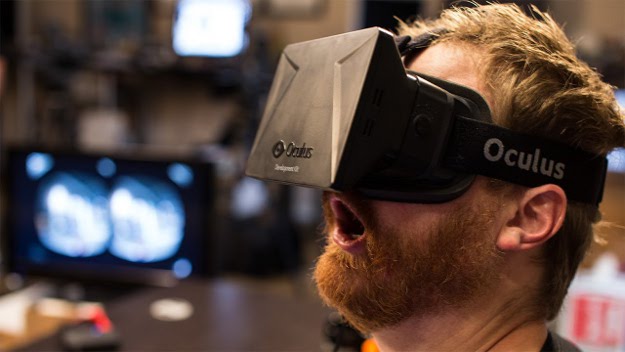
Some more related info on the you-can-go-see-it level. You might have heard of this virtual reality tech, the Oculus Rift. You can find out what it is in further details elsewhere on the internet, but basically it is this head-mounted-display that make wearers experience VRs in very immersive ways. The tech has a lot of potential beyond VR gaming. It is being picked up in many fields and devised for all kinds of uses in sciences and arts.  It's exciting to read about, but I think it's also one of those things that you have to try it on to be truly convinced. 

You can't buy it yet but Rotterdam's Het Nieuwe Instituut museum have one for visitors to try. I have tried it. I am convinced. The "game" they have (it's more like an architectural-conceptual project) is a biking simulation, you play by riding on an actual physical bike that's equipped with input devices, while wearing the OR. You can control your in-game directions with the handlebar and your in-game speed with the pedalling. The twist is that you bike in a VR that has incredible colours, scary slopes and crazy gravity. And the experience is REALLY like biking in this strange world. Your physical movements have in-game consequences. Move your head and you can see the virtual world around you. Move your feet faster and you ride faster. Move your hands to turn the handlebar, you make a turn. What the hell. What the hell. This is like, for real, dude.

It helped me to imagine the religious modelling mentioned above. It helped me imagine many things. If this biking experience was possible then a lot of things are too. You can go see it for yourself. It's on the museum's first floor, next to some legos.

--
Het Nieuwe Instituut came to be as the merge of several organisations in 2013. One of these was the previous Netherlands Architecture Institute. They have developed this smartphone app, Urban Augmented Reality (UAR), that allows you to see the architectural past, present and future of many places in Rotterdam (as well as other cities in the Netherlands). The app is maintained and updated. I need to check it out when I get some of this internet on my phone. If you already have a connected smartphone then you can do it before me. What I have already noticed though, is this ad in the city and its tagline: See what isn't there.

I think it's the perfect starting point for AR applications at large. Why would people want to see something that isn't there? We can think of many reasons, including some religious ones. Maybe AR tech has mad potentials for post-modern new-religious-movements. Can we create a religion simply by designing an AR app? Time may tell.

Wednesday, 22 January 2014

Sunrise Views at Kralingse Zoom Parking Garage


I wrote about how the Kralingse Zoom parking garage is probably a pretty good spot for watching sunset and/or sunrise. I have since seen both. The sunset is not entirely visible because it sets behind the city buildings in the east, you cannot see the moment it goes down. The colours can still be quite impressive if the weather is good and the lights from the sunset act to engulf and delineate the Rotterdam skyline.

The sunrise, though, gives a more instantaneously stimulating visual (as shown in these photos). It's legitimately print-on-calendar stuff. I know that's not the best way to describe any scenery but I guess the sentiment I'm looking for is "objectively beautiful". That's a paradoxical phrasing too. What I really mean is it fits within an average human conception of what beauty is. I have no contention with this ordinary standard. People travel to extraordinary places, climb mountains and hike for hours in search for the ordinarily-beautiful. It excites me to be able to find that kind of beauty in a place as ordinary as a parking garage next to a metro station. It only makes sense, no?


As mentioned in my previous post, the parking garage in open 24/7. The schedule for the sunrise and sunset in the Netherlands is here. You can come to the spot to witness some natural beauty any day (given that it is not too cloudy). Be reminded, of course, to always have protection for your eyes and do not look into the sun otherwise. It can be dazzling and even dangerous

--
The sunrise and sunset are not the only moments worth seeing. The twilight just before the sunrise has a great vibe of anticipation and the charming sense of an in-between.


You may also direct your attention to the moon. I still have to figure out how to capture it on camera so it doesn't look like a blot of light, but here is a moment (around sunset) where the moon is directly above Capelle's Crystal Buildings.


Surely the magically adept can utilize this setting for some ritualistic visualisations? The movements of the sun and the moon can be, especially at seasonal markings like the equinox or the solstices, symbolically significant. Back in agricultural times, the seasons dictated everyone's agenda. The coming and going of sky entities was the coming and going of life. They were some of our oldest gods.

--


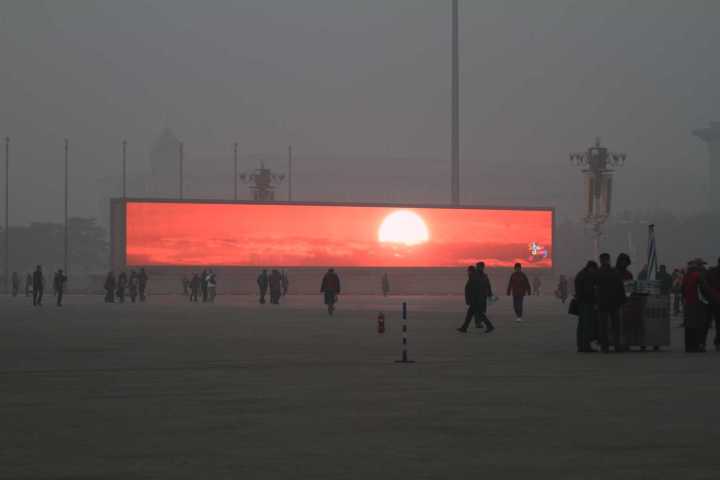
Have you read that recent news story on how the Chinese government had set up an artificial digital sunrise in Beijing's Tiananmen Square, because the pollution is so terrible that the people cannot see the real thing anymore? It has now been proven to be an imagined story, the product of poor journalistic research. Nevertheless, the story was only plausible because we have developed the means and contexts for this practice. Our technology cannot completely replicate the natural sunrise, but it is capable of creating some kind of representation that is probably good enough for aesthetic purposes. We may argue that the technique of representation itself, or language, is one of our most useful technologies. In representations it is possible to make anything.

The things we can make for real are also pretty impressive. The closest we ever got to REALLY making suns was probably by setting off nuclear bombs. They used to watch those in Las Vegas back in the 50s. The Nevada nuke testing schedules were made public at the time, and Vegas planned parties around the detonations. Typically, at the end of the party around 4am, a bomb would set off and people can witness its thrilling display while sipping on cocktails. You need something strong to chase down deathly sights like that. These were instruments of destruction on scales previously only depicted in myths. It's almost like the work of a new god, except it's just us. Extra scary!