Showing posts with label new media. Show all posts

Monday, 24 March 2014

who owns the message


"In Rotterdam we speak Dutch THE TRUTH"


"Rotterdam is for you and not for THE criminals GOVERNMENT"
--
The implications in the graffiti here is that these political campaign ads do NOT speak the truth. But who does? I mean, I love slogans, they're great for motivating and inspiring people, they're great for catching our attention. But after our attention is caught, there needs to be discursive follow-through, because slogans are, by their brevity, not very meaningful. The graffiti artist, the urban communication activist, may be able to appropriate a slogan for it to express an alternative sentiment. But powerful actors such as the VVD have much more than slogans, they have the communicational resources to explain and elaborate on their claims, they have opportunities to make arguments to an audience outside of these posters.  The graffiti only has the resources to an extra glance. Truth or not, they do not have the resources to speak.

In the very very near future or even in a futuristic now, the technology of augmented reality allows for an alternative model. Imagine that you lift up your mobile device to look at this altered, graffiti'd poster through the device's camera, and upon detection of this trigger, the device automatically directs you to an online essay which relates a fully fledged-out alternative viewpoint regarding these issues. (Or, alternatively, nevermind that AR stuff, imagine graffiti + a QR code sticker.) How's that for a public sphere? I say heck yes. Now that's communication empowerment.

--
Speaking of the politics of protest, this is not really Rotterdam related but in my hometown Taipei people are protesting on the streets against the government. I abuse use this channel to invite you to pay a little bit of attention to this development that so far isn't getting much coverage on international media.  I'm not really going to discuss the politics of politics here, but I'm quite impressed by the protesters' communication approach. They have new-media professionals among their ranks and they have set up various internet-live-streams around the protests, allowing the world to see what's happening first hand. They even crowd-sourced people to type up live transcripts to what is said by main speakers on the protest's frontlines. They crowd-sourced translators to translate the live transcripts to English so people like you may read it too (the Eng ver. is a few hours behind now but I say they deserve a break). 

They have even arranged for online crowd-funding to buy off the frontpage ads in major newspapers in the country, to put up protest materials. They got the money so fast that they then decided it's probably possible to buy off the frontpage ad of New York Times International. They already got that money too, the ad might be up on NYTI pretty soon, Taiwanese Americans are helping them on that. Social movements are, by definition, crowd-sourced, and the internet allows for that on a whole new level. It's quite beautiful.

Thursday, 30 January 2014

more levels of reality


Outside the Media Markt in Rotterdam's city centre, there is an augmented reality (AR) billboard ad for Samsung. In this ad, an animated T-Rex takes a short stroll among the crowd and lets out a screen-shaking roar. National Geographic did a similar installation in Rotterdam Central Station a while ago, also featuring a T-Rex in addition to other dinosaurs, animals, a thunderstorm and an astronaut. I'm quite fond of these ads and I'm hoping to see public AR installations like these include crazier imageries in the future. 

I wrote about AR before in a broader definition of constructing new realities, but I have since realized that Augmented Reality really refers to the specific technical application of creating real-time computer generated graphics in a live video feed. I think I've mixed it up with Alternate Realities (AR). I should note that these are different concepts, but they can overlap, and I get specifically thrilled when they do (does that sound twisted?). I think I therefore intuitively imagine every augmented reality as an alternate reality, for my own mental satisfaction. You should note that I still do so in these following paragraphs.

I have been thinking about this AR overlap and its theological implications. In the Media Markt Samsung AR, I see myself (as recorded on a live camera) in a world where everything else is the same except that the T-Rex still lives and may endanger me. Let's say if in this AR the computer-generated T-Rex is programmed to eventually proceed to eat me (on screen). That's pretty easy to picture, no? The next step is to imagine that instead of a T-Rex, this AR features Roman soldiers, and instead of eating me, they crucify me. Whose souls do I save?

A possible Christian application of AR may be to model the Trinity experience in order to help (non)believers understand what it means.  Looking at AR from a 3rd person point of view, as in the example of this Samsung billboard, can be a model for the over-seeing perspective (the Father). Looking at the exact same AR through a 1st person view (a la virtual reality) can be a model for the experiential perspective (the Son). The Holy Spirit can be something in between. The software can be designed so that the user can experience a Jesus story in 3 modes, 3 narrative styles, being able to switch between them at any time. The Son is a fully player-controlled avatar, while every other human beings (like those Romans) are NPCs functioning on pre-created AI... (What moral responsibilities does the player have while in a simulation?)

I don't know if that's sacrilegious. I guess the potential controversy lies in the assumption that "if we try to put it in a software model then we devalue God's unknowable workings". But if humans were created in God's image then it is only reasonable to expect that we can (and eventually will) try to do everything that he does. When I was younger and still somewhat religious I believed God to be a version of myself, and having this guy in charge made me feel okay. I believe in different things now but sometimes I still like to entertain this sentiment. It'd be nice to have a software model to help me do that.

--
bgr.com

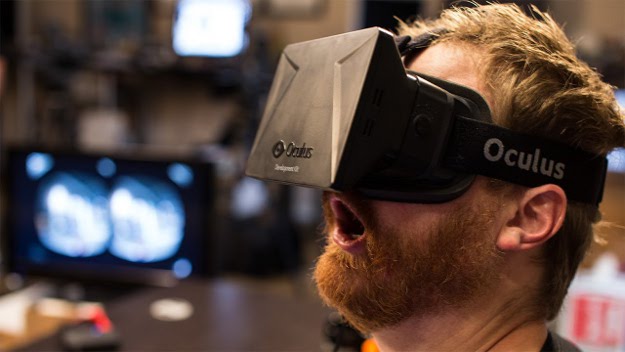
Some more related info on the you-can-go-see-it level. You might have heard of this virtual reality tech, the Oculus Rift. You can find out what it is in further details elsewhere on the internet, but basically it is this head-mounted-display that make wearers experience VRs in very immersive ways. The tech has a lot of potential beyond VR gaming. It is being picked up in many fields and devised for all kinds of uses in sciences and arts.  It's exciting to read about, but I think it's also one of those things that you have to try it on to be truly convinced. 

You can't buy it yet but Rotterdam's Het Nieuwe Instituut museum have one for visitors to try. I have tried it. I am convinced. The "game" they have (it's more like an architectural-conceptual project) is a biking simulation, you play by riding on an actual physical bike that's equipped with input devices, while wearing the OR. You can control your in-game directions with the handlebar and your in-game speed with the pedalling. The twist is that you bike in a VR that has incredible colours, scary slopes and crazy gravity. And the experience is REALLY like biking in this strange world. Your physical movements have in-game consequences. Move your head and you can see the virtual world around you. Move your feet faster and you ride faster. Move your hands to turn the handlebar, you make a turn. What the hell. What the hell. This is like, for real, dude.

It helped me to imagine the religious modelling mentioned above. It helped me imagine many things. If this biking experience was possible then a lot of things are too. You can go see it for yourself. It's on the museum's first floor, next to some legos.

--
Het Nieuwe Instituut came to be as the merge of several organisations in 2013. One of these was the previous Netherlands Architecture Institute. They have developed this smartphone app, Urban Augmented Reality (UAR), that allows you to see the architectural past, present and future of many places in Rotterdam (as well as other cities in the Netherlands). The app is maintained and updated. I need to check it out when I get some of this internet on my phone. If you already have a connected smartphone then you can do it before me. What I have already noticed though, is this ad in the city and its tagline: See what isn't there.

I think it's the perfect starting point for AR applications at large. Why would people want to see something that isn't there? We can think of many reasons, including some religious ones. Maybe AR tech has mad potentials for post-modern new-religious-movements. Can we create a religion simply by designing an AR app? Time may tell.

Monday, 16 December 2013

levels of reality


I liked this ad for the simple reason that it is a billboard inside a billboard. The augmented reality element is a big thing for the PS4 and the ad communicated the idea of gaming-as-AR pretty well. What it also does is inviting the imagination to explore what AR can potentially be. Wouldn't this ad be more relevant if the city depicted on-board IS Rotterdam? If the battle-scene on the ad takes place IN this very location in the city? If the hands holding onto the ropes are actually my hands? In the not-so-distant future where AR technology had matured and google-glass-style vision-alteration devices become prevalent, this type of location-specific and/or viewer-specific advertisement may become standard. You and I can configure our visions in different ways, such that when we look at this billboard we will see different things. Hell, we might not need a billboard at all. Ads can literally hide behind every corner and then pop out to individually scare you like some intrusive reality-TV asshole.

AR facilitates a post-modern definition of the world. What's the difference between hallucinating an unicorn and seeing it on your AR glasses display? In both scenarios the horny fucker is only visible to you. It does not exist in the objective reality. Maybe the objective reality will soon become too boring and therefore obsolete.

In accordance to the perspective of this blog, I may in fact argue that the objective reality is ALREADY boring and obsolete. Why look at anything as it physically IS, when with mindfulness we can see so much more? The human consciousness is naturally capable of AR. Take the example of Feng-Shui: Asian geomancers and their followers observe and analyse geographic elemental energy-flows that are not objectively measurable. These Feng-Shui considerations are often seriously taken into account by architects in Asia, as they design their buildings and cities. They see a relevant reality that the uninitiated ones cannot, and then they operate in this reality. We may say that to study Feng-Shui is to enter and engage a specific FS AR. Now imagine a Feng-Shui app developed for the Google Glass. This app can use geolocation and google maps coupled with a database of Feng-Shui rules, to calculate and display the Feng-Shui qualities of any place on the planet. What it really does, however, is only conveniently presenting a visualisation of an augmented reality that already exists in geomancers' minds. This app does not create an AR, but rather translate an existing AR into visuals that are accessible to everyone.

Having access to the visualisation of Feng-Shui does not make one into a geomancer, for seeing does not equal to believing nor understanding. But it does make both of those processes easier. I imagine that such an app would make a great education/visualisation/initiation instrument.


While we talk about visualisation instruments we may also discuss a different technological approach. Instead of a fabricated digital reality that only exists on screen, we can create tangible scale-models. Scale models are definitely real objects in the objective reality, but at the same time they are also representations, and there is tension in this duo-quality of theirs. In the setting of the Blaak Markthal construction site, we see the arched structure existing in 3 different levels of reality. There's a small representation inside of a bigger representation, set in front of the REAL SIZE THING. The size is, of course, not the only differentiating factor, as each of the two representations draw attention to different aspects of the building, while the actual building is not complete (although it is more complete now than it was when I took the photos). The models represent a Markthal in the future, which as of this moment does not exist yet. They communicate a reality that objectively is not yet, but one that already exists in the minds of city planners and architects and construction workers, and also in the schedule.

Now what if I create a model for a reality that only exist in my own schedule, and you create one that only exists in yours? When we do, are we also creating a style of ARs according to our subjectivities? In a previous post I mentioned Kraków Szopki. These models, although not to-scale, are meant to represent some aspects of the city of Kraków, according to the individual craftsman's interpretation. They take inspirations from local architecture and culture and construct these elements into an imagined amalgam reality. Of course in the objective reality Jesus wasn't born in any cathedral or castle in Kraków, but in the AR of Szopki he was born in Kraków many many times.