Showing posts with label religions. Show all posts

Saturday, 14 May 2016

National Exhibition of Bollards


I still remember the first time I saw these poles from across the street, and my immediate reaction was that "duuuude this is GIR as fuuuck". Maybe I should work on being able to pause this GIR-radar from my urban perception.  Maybe it distracts/distorts a direct and natural interaction with the city. Writing this blog had, in some ways, influenced what I tend to pay attention to when I walk on the streets. And as you know, to pay attention to something is also (by definition) to ignore something else. Attention is psychic energy and I only have so much. When will I get omniscience? I wonder if King Solomon had that. I wonder if ultimate wisdom can enable one to simulate omniscience. I wonder if the Masons know some techniques in the art of maximising psychic energy and experiencing the universe as built space.

I digress! These poles, or as I've since learned are called 'bollards', convene on a street corner at Vierambachtsstraat in Rotterdam's Nieuwe Westen. The open space is labelled  "Landelijk Tentoonstelling Voor Paal", or "National Exhibition of Bollards". The bollards of  different shapes, sizes and purposes are brought in from various cities in the Netherlands and collected in one location here. I read that the local resident's organisation set it up in 1994. Whoever that dreamt up this idea must have had a charismatic and affective mind. Building something like this really is an act of empowerment. It is one thing to travel around the country, taking mental pictures of different traffic poles and proclaim that your brain contains a National Bollard Compendium. It is another thing to build the compendium into a physical museum, so that anyone in the presence of the collection has immediate experience to the national variations of this specific street-furniture item. How different can Dutch cities be, when it comes to small details on their street sides? Here is exactly how different they can be. Look. You can see. You can even touch. Feel the difference. Go on. Yes, that IS concrete with extra gravel.


I don't think I have a favourite, although there are some specific ones that I liked.


This thing with a little blue house is nice. It could be a shrine. Maybe as an impromptu mini temple, you could place a small idol in the house and quickly say a prayer. Next person, next sacred item in-house, next god, next religion. Modular micro-worship spot for a multi-religious community. Utopic!


This one is made of wood and looks like it belongs in water. I'm quite sure I've seen others like it in canals and the sides of lakes. It is extra exceptional, then, to see it on land. 


"Chaining totems". Ok that doesn't really sound like Channing Tatum. Forced jokes are embarrassing. I remember one time I've seen a toddler trying very hard to step over a chain hung between two poles just like this. I watched the kid struggle for a while, and then, in demonstration of my adult manoeuvrability, I walked up and gracefully hopped over the chain, or anyways I tried. The chain caught my foot, I tripped and fell and almost face-planted on the pavement.  Hahaha.


I'm not sure what these guys are supposed to be. A couple? Two dancers shortly before a duet? Rival swordsmen? Two raindrops one millisecond after impacting the ground? All of the above?


This pyramid is kind of like a centrepiece of the exhibition. I like to imagine that it is a live-size pyramid (like those at Giza), and the other poles ancient skyscrapers made of metal and stone. The entire site become mythological and epic from the perspective of an ant-size observer. That's the magic of proportions, no? If you imagine your "true self" resting in an infinitely small centre core of your body, then your physical body becomes like the size of an universe.

I should probably stop demonstrating my imaginaut manoeuvrability before I trip myself some more. The exhibition could look like many things (a chess game frozen in time, a graveyard, a system of sun dials etc etc), but there is tremendous charm and wonder in what it already is. It's just visually amusing to see all these poles hanging out here. I read that local people sometime use this space as a meeting spot. You can even sit on some of the shorter bollards. It's basically brilliant. I dunno if GIR can ever be a physical museum as great as this one, but I hope that these words at least offers an urban mental space for you guys to hang out. I'm hanging here all the time. Jeez, who needs omniscience when you have GIR? Why would I ever pause my GIR radar? I fucking love it.

Thursday, 30 January 2014

more levels of reality


Outside the Media Markt in Rotterdam's city centre, there is an augmented reality (AR) billboard ad for Samsung. In this ad, an animated T-Rex takes a short stroll among the crowd and lets out a screen-shaking roar. National Geographic did a similar installation in Rotterdam Central Station a while ago, also featuring a T-Rex in addition to other dinosaurs, animals, a thunderstorm and an astronaut. I'm quite fond of these ads and I'm hoping to see public AR installations like these include crazier imageries in the future. 

I wrote about AR before in a broader definition of constructing new realities, but I have since realized that Augmented Reality really refers to the specific technical application of creating real-time computer generated graphics in a live video feed. I think I've mixed it up with Alternate Realities (AR). I should note that these are different concepts, but they can overlap, and I get specifically thrilled when they do (does that sound twisted?). I think I therefore intuitively imagine every augmented reality as an alternate reality, for my own mental satisfaction. You should note that I still do so in these following paragraphs.

I have been thinking about this AR overlap and its theological implications. In the Media Markt Samsung AR, I see myself (as recorded on a live camera) in a world where everything else is the same except that the T-Rex still lives and may endanger me. Let's say if in this AR the computer-generated T-Rex is programmed to eventually proceed to eat me (on screen). That's pretty easy to picture, no? The next step is to imagine that instead of a T-Rex, this AR features Roman soldiers, and instead of eating me, they crucify me. Whose souls do I save?

A possible Christian application of AR may be to model the Trinity experience in order to help (non)believers understand what it means.  Looking at AR from a 3rd person point of view, as in the example of this Samsung billboard, can be a model for the over-seeing perspective (the Father). Looking at the exact same AR through a 1st person view (a la virtual reality) can be a model for the experiential perspective (the Son). The Holy Spirit can be something in between. The software can be designed so that the user can experience a Jesus story in 3 modes, 3 narrative styles, being able to switch between them at any time. The Son is a fully player-controlled avatar, while every other human beings (like those Romans) are NPCs functioning on pre-created AI... (What moral responsibilities does the player have while in a simulation?)

I don't know if that's sacrilegious. I guess the potential controversy lies in the assumption that "if we try to put it in a software model then we devalue God's unknowable workings". But if humans were created in God's image then it is only reasonable to expect that we can (and eventually will) try to do everything that he does. When I was younger and still somewhat religious I believed God to be a version of myself, and having this guy in charge made me feel okay. I believe in different things now but sometimes I still like to entertain this sentiment. It'd be nice to have a software model to help me do that.

--
bgr.com

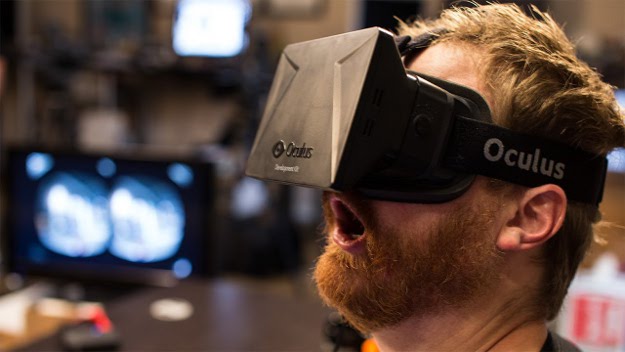
Some more related info on the you-can-go-see-it level. You might have heard of this virtual reality tech, the Oculus Rift. You can find out what it is in further details elsewhere on the internet, but basically it is this head-mounted-display that make wearers experience VRs in very immersive ways. The tech has a lot of potential beyond VR gaming. It is being picked up in many fields and devised for all kinds of uses in sciences and arts.  It's exciting to read about, but I think it's also one of those things that you have to try it on to be truly convinced. 

You can't buy it yet but Rotterdam's Het Nieuwe Instituut museum have one for visitors to try. I have tried it. I am convinced. The "game" they have (it's more like an architectural-conceptual project) is a biking simulation, you play by riding on an actual physical bike that's equipped with input devices, while wearing the OR. You can control your in-game directions with the handlebar and your in-game speed with the pedalling. The twist is that you bike in a VR that has incredible colours, scary slopes and crazy gravity. And the experience is REALLY like biking in this strange world. Your physical movements have in-game consequences. Move your head and you can see the virtual world around you. Move your feet faster and you ride faster. Move your hands to turn the handlebar, you make a turn. What the hell. What the hell. This is like, for real, dude.

It helped me to imagine the religious modelling mentioned above. It helped me imagine many things. If this biking experience was possible then a lot of things are too. You can go see it for yourself. It's on the museum's first floor, next to some legos.

--
Het Nieuwe Instituut came to be as the merge of several organisations in 2013. One of these was the previous Netherlands Architecture Institute. They have developed this smartphone app, Urban Augmented Reality (UAR), that allows you to see the architectural past, present and future of many places in Rotterdam (as well as other cities in the Netherlands). The app is maintained and updated. I need to check it out when I get some of this internet on my phone. If you already have a connected smartphone then you can do it before me. What I have already noticed though, is this ad in the city and its tagline: See what isn't there.

I think it's the perfect starting point for AR applications at large. Why would people want to see something that isn't there? We can think of many reasons, including some religious ones. Maybe AR tech has mad potentials for post-modern new-religious-movements. Can we create a religion simply by designing an AR app? Time may tell.

Monday, 9 December 2013

The Library's Chinese Dragon & Kraków Szopki


I grew up in a Christian family and to this day I'm very thankful that my parents were not EXTREMELY PARANOID about it. A group of our Christian family friends were, though, and I remember that they would throw a fit whenever they see an image of a dragon anywhere. They believed it was the power-insignia of Satan and advised everyone to avoid the sight of these things. Consider that we were living in a Chinese cultural environment, this extreme sensitivity to the iconography of the Beast was inconvenient to say the least. The ethnic Chinese sometimes like to identify themselves as, if translated into biblical terminology, Descendents of the Serpent. We love dragons and we have them as decorations everywhere, especially in traditional settings. When these radical Christians go out on the streets during Chinese New Year they grow very distressed. 

A woman from the church had a fight with my grandmother on a visit once, when she insisted that my gran should get rid of these double-blue-dragon porcelain vases in the living room, preferably have them shattered, so that the Beast will not have power over her house. Gran, also a Christian, thought this woman was ridiculous. She never smashed the vases and they haven't spoke much ever since.

Funnily enough, I have come to realize that the woman's line of thoughts wasn't COMPLETELY unreasonable. In the words of Alan Moore, "The one place God inarguably exists is in the human mind.*" For a people whose culture and daily symbols are saturated with Dragons, the Christian God needs to aggressively invade ("evangelize") their mental realities in order to occupy a relevant mindshare. And what's more aggressive and invasive than physically smashing your competitions? If there comes a day when Apple can convince their fans to physically smash up PCs and android phones whenever they see one, commercial brands will have truly become our new gods. I'm sure brands have had their eyes on those thrones for a while.

--
Inside the Rotterdam Central Library, on the 3rd floor, there is a great Chinese Dragon hanging overhead. It was first installed in the tourist information centre (VVV) in late 2012 as a part of the promotional campaign for this China Light Festival in Rotterdam, but they have moved it here after the festival was over.


Its bones are made of metal wires and its flesh a composition of coloured fabric shreds. The Dragon's real construction material, however, is wishes. The sorcerer, or in this case probably a promotional campaign designer, had came up with a ritualistic practice where everyone who visited the VVV could write a new year's wish on a piece of fabric and tie it onto the Dragon's bones. Started as an empty, hollow and colourless skeleton, the Dragon had been given colour and form through the transforming acts of wishing. This is a straight-forward symbolic process. The Dragon had been given life.

In many magical traditions across cultures, people gather the bones of dead animals and/or persons and perform certain rituals on them, which enables the people to interact, on some level, to the dead bodies' original masters. If the communication is conducted correctly, the spirits of the passed can allegedly come back to aid us to divination, protection and various other ends. In the Dragon's case, no real dead body parts were used, but instead an entire artificial body is created in a symbolic procedure. As the Israelites had forged the Golden Calf**, Rotterdamers had patched together a Dragon that according to some has the very shape of Satan himself. Although it was not worshipped per se, it WAS entrusted with people's wishes. Surely most people were not seriously expecting their wishes to be fulfilled by the actual ritual, but on the other hand Abraham's God takes these little things very seriously.

--

***

I only had the idea to write in this terrible conflict frame because, as a part of the Polish-month activities, there's also an Kraków Szopki exhibition going on in the Llibrary. As per my understanding, Szopki are traditionally hand-crafted miniature models depicting the Nativity in the setting of Kraków-styled historical architecture. It's very Christian and very Polish at the same time. Elements of folklore and biblical stories are combined into the craft and designs, and within these Szopki cultural interaction and tension both contribute to the aesthetics of one narrative . These models are going back to Poland after the exhibition (Jan 6th) and I encourage everyone to go take a look while you can.

As Szopki are tiny buildings, the public library is just a bigger building. I think it is exciting that in these shared cultural sites, symbols from different backgrounds and religions old and new all stand their grounds and vie for our attention. In a multi-cultural society that is also an information society, every public space is an arena for ideas, and as ideas do battle, symbols are some of their most powerful weapons****. And then, if we take advantage of an Asiatic martial-arts metaphor here, every battle is also a conversation.

Also I don't know where else to fit this into the post but in one of the Szopki, Death and the Devil BOTH came for King Herod's soul because he fucked up big time. This has gotta be the worst-ever double-trouble scenario and I thought it's absolutely hilarious.


--
*    Alan Moore, "From Hell" (1999)
**   Exodus 32
***  Google automatically generated this gif for me what the hell
**** Kieron Gillen, "Dark Avengers: Ares" (2010)