Showing posts with label street detailing. Show all posts

Saturday, 14 May 2016

National Exhibition of Bollards


I still remember the first time I saw these poles from across the street, and my immediate reaction was that "duuuude this is GIR as fuuuck". Maybe I should work on being able to pause this GIR-radar from my urban perception.  Maybe it distracts/distorts a direct and natural interaction with the city. Writing this blog had, in some ways, influenced what I tend to pay attention to when I walk on the streets. And as you know, to pay attention to something is also (by definition) to ignore something else. Attention is psychic energy and I only have so much. When will I get omniscience? I wonder if King Solomon had that. I wonder if ultimate wisdom can enable one to simulate omniscience. I wonder if the Masons know some techniques in the art of maximising psychic energy and experiencing the universe as built space.

I digress! These poles, or as I've since learned are called 'bollards', convene on a street corner at Vierambachtsstraat in Rotterdam's Nieuwe Westen. The open space is labelled  "Landelijk Tentoonstelling Voor Paal", or "National Exhibition of Bollards". The bollards of  different shapes, sizes and purposes are brought in from various cities in the Netherlands and collected in one location here. I read that the local resident's organisation set it up in 1994. Whoever that dreamt up this idea must have had a charismatic and affective mind. Building something like this really is an act of empowerment. It is one thing to travel around the country, taking mental pictures of different traffic poles and proclaim that your brain contains a National Bollard Compendium. It is another thing to build the compendium into a physical museum, so that anyone in the presence of the collection has immediate experience to the national variations of this specific street-furniture item. How different can Dutch cities be, when it comes to small details on their street sides? Here is exactly how different they can be. Look. You can see. You can even touch. Feel the difference. Go on. Yes, that IS concrete with extra gravel.


I don't think I have a favourite, although there are some specific ones that I liked.


This thing with a little blue house is nice. It could be a shrine. Maybe as an impromptu mini temple, you could place a small idol in the house and quickly say a prayer. Next person, next sacred item in-house, next god, next religion. Modular micro-worship spot for a multi-religious community. Utopic!


This one is made of wood and looks like it belongs in water. I'm quite sure I've seen others like it in canals and the sides of lakes. It is extra exceptional, then, to see it on land. 


"Chaining totems". Ok that doesn't really sound like Channing Tatum. Forced jokes are embarrassing. I remember one time I've seen a toddler trying very hard to step over a chain hung between two poles just like this. I watched the kid struggle for a while, and then, in demonstration of my adult manoeuvrability, I walked up and gracefully hopped over the chain, or anyways I tried. The chain caught my foot, I tripped and fell and almost face-planted on the pavement.  Hahaha.


I'm not sure what these guys are supposed to be. A couple? Two dancers shortly before a duet? Rival swordsmen? Two raindrops one millisecond after impacting the ground? All of the above?


This pyramid is kind of like a centrepiece of the exhibition. I like to imagine that it is a live-size pyramid (like those at Giza), and the other poles ancient skyscrapers made of metal and stone. The entire site become mythological and epic from the perspective of an ant-size observer. That's the magic of proportions, no? If you imagine your "true self" resting in an infinitely small centre core of your body, then your physical body becomes like the size of an universe.

I should probably stop demonstrating my imaginaut manoeuvrability before I trip myself some more. The exhibition could look like many things (a chess game frozen in time, a graveyard, a system of sun dials etc etc), but there is tremendous charm and wonder in what it already is. It's just visually amusing to see all these poles hanging out here. I read that local people sometime use this space as a meeting spot. You can even sit on some of the shorter bollards. It's basically brilliant. I dunno if GIR can ever be a physical museum as great as this one, but I hope that these words at least offers an urban mental space for you guys to hang out. I'm hanging here all the time. Jeez, who needs omniscience when you have GIR? Why would I ever pause my GIR radar? I fucking love it.

Wednesday, 18 February 2015

Details: Stamp Machines and foot-printed map (Rotterdam Central Station)

Genpei Akasegawa (RIP) is a major inspiration for this blog.  In the mid 80s, he and several other Japanese architects/artists founded the Roadway Observation (RoJo) Society. This group produced tremendous fieldwork on observations and recordings of objects in the urban environments, objects that are often otherwise overlooked and ignored. I think the keyword is objects. The group was not primarily interested in contexts or in the broader social/cultural structures in which these objects existed. They simply took pleasure in admiring the details of the littlest things. Another way to describe their practice was 'Street Detailing'. 

I'm considering copying/echoing some of this group's methodologies in Rotterdam. I want to go hunt for Genpei Akasegawa's Thomassons, and I want to imitate Joji Hayashi's process of observing and typifying manhole covers. Before I do any of that, I thought I would do smaller spontaneous sessions to test the waters. The other night I tried to perform some detailing in Rotterdam Central Station. I'll talk about some objects I saw.

--


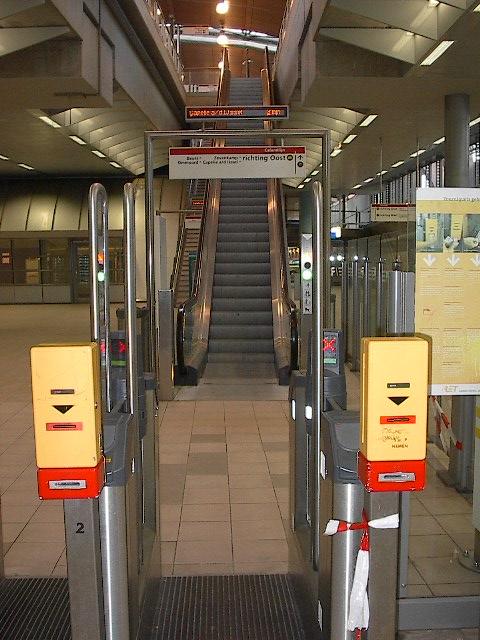
Two stempelautomaten, or 'stamp machines', are located outside the main Metro entrance in Rotterdam's Central Station. If you were living in the Netherlands before 2010 or so, you might remember that before the OV Chipkaart system was introduced, we used paper tickets for public transport, and the tickets had to be stamped by the stempelautomaat to be validated.  These yellow porters were made figures of authority. It was only with their approval that we were allowed to travel. It was kind of like going through customs at the boarder and needing to have your passport stamped by some bureaucrat. In truth, machines of this nature can be the perfect bureaucrat. 

Alas, the glory days of the yellow bureaucrats had passed, the paper tickets are now completely phased out (since July 2014), and the stamp machines are put out of work. If an innovative repurposing does not come into the picture soon, these machines are also practically put on death row. Currently they are tied up to metal poles in this busy transit spot for (shameful) public display of a medieval fashion, made examples of as bureaucratic figures from a bygone era who had become useless and obsolete. The two machines, numbered 15 and 16, are kept alive for now, as they're still each hooked into the power supply. I don't know when they will finally be disposed, but you can drop by and offer them some consolation before it's too late. Maybe even give them a hug. It really helps to get a hug when you're feeling useless, no?

--


These are the granite stairs at the bottom of the metro exit toward the bus stations in Rotterdam Central. At the lowest stair there is a strip of exposed cement. I'm not sure what's the functionality of this design but I've seen it on several of these granite stairs in Central Station. I would like to figure  out their original purpose soon.

Anyways I paid specific attention to the ones in the picture because they are imprinted with distinguishing patterns. These were probably footprints on wet cement. But they look like maps of some areas in Rotterdam's inner city (near the river). It is most likely a random pattern and this map-look is a beautiful illusion. But let's envision alternative scenarios where it is not:


What if... the inner city map is patternised and strategically used as decoration around the exits of public transport stations? 

What if... special shoes were issued for those (cement pourers) employed by the municipality, shoes that have the city map engraved onto their soles? And extending this shoe idea, what if your footprint actually prints something meaningful, and by simply walking about you are taking your city to every place you've been to? People had tried to put maps on shoes, but I haven't seen anyone try to put maps under them. Those would be the perfect shoes to express someone's emotional connection to a specific city. Imagine that wherever you walk to in the world, you are still always walking on the streets of your hometown...

Maps can be the best kind of summary of how a city physically IS. It is, then, extremely suitable to use this visual summary for symbolic purposes. Appropriating maps into usable symbols and patterns is, I think, a crucial design task for every city and even every city district.