
Outside the Media Markt in Rotterdam's city centre, there is an augmented reality (AR) billboard ad for Samsung. In this ad, an animated T-Rex takes a short stroll among the crowd and lets out a screen-shaking roar. National Geographic did a similar installation in Rotterdam Central Station a while ago, also featuring a T-Rex in addition to other dinosaurs, animals, a thunderstorm and an astronaut. I'm quite fond of these ads and I'm hoping to see public AR installations like these include crazier imageries in the future.
I wrote about AR before in a broader definition of constructing new realities, but I have since realized that Augmented Reality really refers to the specific technical application of creating real-time computer generated graphics in a live video feed. I think I've mixed it up with Alternate Realities (AR). I should note that these are different concepts, but they can overlap, and I get specifically thrilled when they do (does that sound twisted?). I think I therefore intuitively imagine every augmented reality as an alternate reality, for my own mental satisfaction. You should note that I still do so in these following paragraphs.
I have been thinking about this AR overlap and its theological implications. In the Media Markt Samsung AR, I see myself (as recorded on a live camera) in a world where everything else is the same except that the T-Rex still lives and may endanger me. Let's say if in this AR the computer-generated T-Rex is programmed to eventually proceed to eat me (on screen). That's pretty easy to picture, no? The next step is to imagine that instead of a T-Rex, this AR features Roman soldiers, and instead of eating me, they crucify me. Whose souls do I save?
A possible Christian application of AR may be to model the Trinity experience in order to help (non)believers understand what it means. Looking at AR from a 3rd person point of view, as in the example of this Samsung billboard, can be a model for the over-seeing perspective (the Father). Looking at the exact same AR through a 1st person view (a la virtual reality) can be a model for the experiential perspective (the Son). The Holy Spirit can be something in between. The software can be designed so that the user can experience a Jesus story in 3 modes, 3 narrative styles, being able to switch between them at any time. The Son is a fully player-controlled avatar, while every other human beings (like those Romans) are NPCs functioning on pre-created AI... (What moral responsibilities does the player have while in a simulation?)
I don't know if that's sacrilegious. I guess the potential controversy lies in the assumption that "if we try to put it in a software model then we devalue God's unknowable workings". But if humans were created in God's image then it is only reasonable to expect that we can (and eventually will) try to do everything that he does. When I was younger and still somewhat religious I believed God to be a version of myself, and having this guy in charge made me feel okay. I believe in different things now but sometimes I still like to entertain this sentiment. It'd be nice to have a software model to help me do that.
--
 |
| bgr.com |
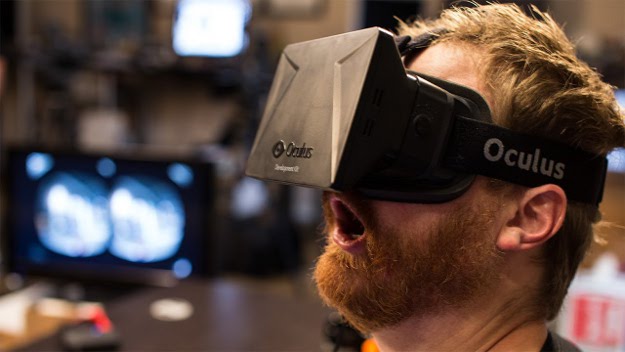
Some more related info on the you-can-go-see-it level. You might have heard of this virtual reality tech, the Oculus Rift. You can find out what it is in further details elsewhere on the internet, but basically it is this head-mounted-display that make wearers experience VRs in very immersive ways. The tech has a lot of potential beyond VR gaming. It is being picked up in many fields and devised for all kinds of uses in sciences and arts. It's exciting to read about, but I think it's also one of those things that you have to try it on to be truly convinced.
You can't buy it yet but Rotterdam's Het Nieuwe Instituut museum have one for visitors to try. I have tried it. I am convinced. The "game" they have (it's more like an architectural-conceptual project) is a biking simulation, you play by riding on an actual physical bike that's equipped with input devices, while wearing the OR. You can control your in-game directions with the handlebar and your in-game speed with the pedalling. The twist is that you bike in a VR that has incredible colours, scary slopes and crazy gravity. And the experience is REALLY like biking in this strange world. Your physical movements have in-game consequences. Move your head and you can see the virtual world around you. Move your feet faster and you ride faster. Move your hands to turn the handlebar, you make a turn. What the hell. What the hell. This is like, for real, dude.
It helped me to imagine the religious modelling mentioned above. It helped me imagine many things. If this biking experience was possible then a lot of things are too. You can go see it for yourself. It's on the museum's first floor, next to some legos.

Het Nieuwe Instituut came to be as the merge of several organisations in 2013. One of these was the previous Netherlands Architecture Institute. They have developed this smartphone app, Urban Augmented Reality (UAR), that allows you to see the architectural past, present and future of many places in Rotterdam (as well as other cities in the Netherlands). The app is maintained and updated. I need to check it out when I get some of this internet on my phone. If you already have a connected smartphone then you can do it before me. What I have already noticed though, is this ad in the city and its tagline: See what isn't there.
I think it's the perfect starting point for AR applications at large. Why would people want to see something that isn't there? We can think of many reasons, including some religious ones. Maybe AR tech has mad potentials for post-modern new-religious-movements. Can we create a religion simply by designing an AR app? Time may tell.

.JPG)

