Showing posts with label art. Show all posts

Thursday, 14 June 2018

The Society of the Spectrecle


(Nieuwe Binnenweg except if you were super-dimensional and could walk from and to both ends of the street at the same time.)

When I was about 14, we went on a school trip to the city of York in northeast England. One of the things we did was participating in a Ghost Tour. The curious activity consisted of a guide leading us (a group of maybe 30 kids) through the historical streets of  York city centre, while giving us several accounts of paranormal haunting that were attached to storiful locations along the route. The specific mental image is fuzzy by now, but I am 80% certain he had a top-hat and a cane. The experience was coloured with a kooky(-cutter) halloween charm, and I think back to it fondly. I guess it was my first-ever exposure to a cliché form or any form of psychogeography. The notion that places can be populated by stories, which is to say space can be filled with people and events of the (possible) past, came not as revelation but more as reminder. Of course that's true, that much of human reality is just stories. When I was a slightly older teenager I remember explaining to a friend this theory of how ghosts are just the universe's way of recording human beings' interactions with the universe itself. The guy was not convinced but I was.

I do remember several stories from York. This is impressive because I don't even remember many things I've done myself from that relatively distant time. There was a loyal dog trapped in cement in the church's groundwork, barking still at the exact same hour every day, trying to alert his owner of certain danger (serving also as a grimmer version of the church bells). There was the ghosts of an entire Roman legion marching through the houses and cafés , heading toward their original destination but stuck in the timeless action of ghostly mobility. There were the small feeble touches of starved children from times of urban famine, tiny fingers from children's heights reaching for the hands of passer-bys through all eternity, asking for food but are never fulfilled. There was...

Recently I have returned to the earlier habit and hobby of aimlessly walking in Rotterdam (at this point I feel pretentious to call it "flaneren" or "dérive"). A new area of attention is how the streets are filled with the stories of my own lived experience and interactions with others in this city year after year. In a sense these are ghosts of my own making. Over the years I have taken some photos and videos of these experiences in urban space. It wouldn't be such a stretch to geotag these media artifacts with locational information and place them on a map-interface. It would be like a google streetview merged with my own memories, a personalised ghostropolis.

We walked down Nieuwe Binnenweg as it was made pedestrian-only on King's Day, and I stupidly said that the guys in great local bands are starting to be younger than me now. Or I walked to a party in heavy rain to see somebody because I was dumb (still am) and my shoes were super wet (Why did I walk from Blaak to Rotterdam Noord in the rain? Wasn't there a tram?). Or probably the last time I played music in the city on the side of the small bridge on Hoogstraat, when some guy asked me to teach him how to play the guitar, and I ended up really giving him a few lessons, even when I was hardly qualified (but in punk if you know how to play 2 chords you can teach somebody who only knows 1 chord. This is the only way we will get by). And this and that.

More recent and intense is a piece of urban memory that is, in this line of thinking, ghost-on-ghost action. We played Pokemon Go around Halloween time and there was a special in-game event where the game space is saturated with ghost-type Pokemons such as Gengar and Duskull. This is, I think, the closest we got to combining ghost-hunting with location-based mobile technology. We spent many evenings searching for pokemons in Rotterdam West. It was great fun and very precious. I haven't played much Pokemon Go since. In due time we will play again, but maybe not in Rotterdam unfortunately.  The recent-past versions of us chasing ghosts here are ghosts themselves.

(Here's something I saw on Gouvernestraat. First I thought the most ghostly item in this artwork is the white rectangle at the bottom corner, having a strong presence by means of absence.)


(However as I got closer I reliased that the tree wasn't graffiti, it was actually dead. Maybe the whole situation wasn't planned to look like this at all.  The wall-climbing plant could've died naturally. The story of death and decay only comes alive in the process of death and decay. We can say ghosts are stories that tell themselves.)


--
These ideas may be trite and derivative. As you like to say, with the charismatic confidence of a cult leader receiving compliments, "tell me something new". You also said, of great ideas, something like "not many of them materialise (into successful products or successful businesses)". Indeed, one time I participated in a project in which we came up with a location based augmented-reality ghost-hunting game, but ultimately it didn't materialise. For this project I wrote some characters one could encounter in the AR environment. Some memorable ones are an old pagan god made of an infinite number of hissing and writhing snakes ("Yessss....touch the earth so we may feel your sssskin...") and a (literally) fallen angel who only exists in the sounds of broken wings, and is eager to offer the player knowledge which whilst true may cause him/her great harm.

At the time I didn't think of it like this, but of course that was the first psychogeography project I was involved in the making of.  Maybe that or the first ideas for this blog. It was an incubatory period for my urban imagination. In the present moment I can entertain the narrative that the two projects have come to converge in some way. The version of me which is created in the urban sensibility of GIR can be found in Rotterdam as a ghost, not unlike a loyal dog trapped in concrete eternal (isn't the concrete material ideal for horror stories involving death-by-building-construction?), or a fictional ancient god (should any god be considered ancient if believes are not preserved but rather re-created by every generation of believers?), or a Pokemon creature (imagine playing Pokemon Go but as a pokemon instead of a trainer).

As I was writing this post, I found out that Rotterdam has its own historical ghost tour.
I think I have to see it. Maybe when I do, I can really tell you about something newer than ghosts.

Thursday, 11 September 2014

Nesselande's Light Transmitting Concrete Cubes


We have all heard of concrete jungles, but have you ever imagined a Light-Transmitting-Concrete jungle? What does that even mean?

I read about these Light Transmitting Concrete (LiTraCon), it's a building material combining concrete with optical glass fibres. While maintaining the hardness and weight of concrete, it lets light shine through like traditional asian paper wall. According to the LiTraCon company website, as the optic fibre hardly loses any light through its length, the LiTraCon material is capable of light-transmittance for thickness up to 20 metres. The material catches a unique balance between heavy and light properties and I thought it sounded really exciting. Imagine seeing something lights up through 20 metres thick of concrete! 

And then I found out that the engineering firm Vormtech used this material in 2011 to build street furnitures at a location near the Nesselande beach, to the north-east of Rotterdam. Naturally I had to pay a visit. There were 6 of these LiTraCon cube fixtures along the short Kosboulevard, marking corners of the regular concrete benches. Each of these is a LiTraCon case with light source placed on the inside, and with a fixed metal lid covering the top.


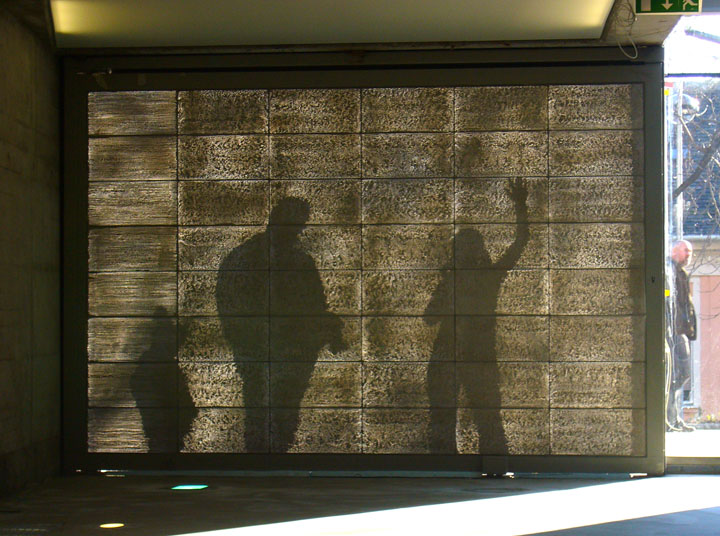
I can see that there is already plenty of regular streetlights in the area, and the way they set up the LiTraCon cubes here is less for illumination and more for decoration. I like the enchanted-runes vibe these cubes give out, it looks like they are inscribed with holy scripture. I like that it's pretty much impossible for external forces to break the lamp inside because they're protected by concrete ( The lamp itself might bust or malfunction though. This was possibly the case with the one cube that was off). But at the end of the day these cubes don't demonstrate my favourite thing about LiTraCon: the way you can cast shadows through it (as sensually presented here).

http://retaildesignblog.net/

When I first saw this material do shadows my intuition speaks shadow puppet theatre. Did I mention LiTraCon also allows colours to shine through? It promises all kinds of exciting visual presentation and connection between both sides of a concrete wall.

From what I've read, LiTraCon cannot (yet!) replace good old concrete because it is way more expensive, so we're not going to see entire concrete structures made of this stuff any time soon. But I'll be very happy to see smart applications of materials like this in cities here and there, infusing the concrete jungle with some visual diversity that any so-called jungle should rightfully include.

--
p.s. originally I wanted to do this blogpost on new technologies and lights, and I was gonn include another location. I tried to visit Daan Roosegaarde's Dune 4.2 interactive installation at Kralingen's De Esch, but the installation was apparently not there any more. I later researched more carefully and found that they removed Dune 4.2 in early 2013. I's been a few years since they set it up (2009) and it makes sense that higher-tech installations don't stay at one location forever.  It's a shame though, I always wanted to see it since it looked hella dope extremely captivating on video.


Sunday, 24 August 2014

Rotterdam Coollection 001

Coollection, a portmanteau, is the collection of cool things. I have coined it just now and the word has a geeky sound to it that I am quite fond of. This is a new kind of posts I'm doing on this blog, where every once in a while I'm going to share a few cool Rotterdam items that I've found on the Internet. Videos, pictures, websites, you name it. Actually I'll name it. Whatever. I'll also put down a few words on why they're cool so you'll have greater insight into my taste in cool things.

--


These guys are doing a project where they travel around the world to shoot rollerblading videos in cities. Sometimes they do tricks. Sometimes they're just fast. They also make cities look very good. In this vid they skate through some of Rotterdam's best-looking places and it's stimulating to see our familiar sceneries re-defined by alternative sets of movements and perspectives. The tracking shots are the best parts. Without rollerblades it would be very difficult to experience these spaces in motion. I mean, sure, you can walk through the Beursplein underground passage, but that's pretty slow.

--


Brett Bogart, now occasionally dubbed the Netherland's Justin Bieber, is a nascent teen-pop sensation from Brabant. He shot this music video for his new single Rooftop on top and around Rotterdam's Schieblock. The video has bright-coloured teen fashion, some cartwheels, several back-flips, and lots of dancing on the rooftop. It's kind of surreal that people born in 1999 are becoming pop stars now. In 10 years' time people born in 2009 are going to be pop stars. Wow. 

snapshot from youtube
Anyways Rooftop is great because while wishing for this video to be an international youtube hit, Brett (and most likely his marketing people) looked for international appeal, and decided on an urban metropolitan feel. Boyz and girlz partying on a rooftop surrounded by sky scrapers, these are colourful kids in a grey city, free and all-so-happy. Naturally they had to film this in Rotterdam because it is the only Dutch city that can pull off this look. After the war, Rotterdam was designed and re-built as the American-styled city of the Netherlands. It had been dubbed accordingly our Manhattan aan de Maas. It is, then, only fitting for the Netherland's JB to shoot his video here.

--


http://ikrotterdam.blogspot.nl/

http://ikrotterdam.blogspot.nl/

ikRotterdam is 3 artists who draw snippets of Rotterdam. They do places, people, objects and whatever else they like. The art is really cool and they make great use of colours to demonstrate that the city doesn't feel so grey after all. The buildings look alive. The human portraits look warm-hearted. They tag each drawing with the area in which its subject matter was seen (Centrum, Delfshaven etc), so you can go and try to find it as well. Their tagline is "I don't need to go on vacation because I live in Rotterdam". It's pretty much how I feel too, but they express it with a charismatic artistic style I wish I had. You can like them on Facebook to get regular updates. I did.

Saturday, 5 April 2014

Crossing Van Brinnenoordbrug


I mostly operate on the north side of the Nieuwe Maas and for all the time I've spent in this great city much of the southern areas remained untrodden by my feet. I thought that's a huge shame and needed to be changed. When I look out from the Kralingse Zoom parking garage  roof I can see this bridge and I figured the city skyline would look pretty swell from that angle. I thought I would stand on the bridge and look at the city, and then walk across and take a look at what's on the other side.

The actual skyline-watching from Van Brinnenoordbrug didn't go as smoothly as I wished. The bridge is a part of the A16 highway and thus functions chiefly as a passing for vehicles. The only possible viewing position for pedestrians is from the bicycle path, and the bridge only has a bicycle path on its eastern side while the city-centre is at its west. When looking at the city from this path, highway cars run between you and the city and they distract your vision. Of course, this visual noise has its own raucous aesthetics and together with the audio traffic noises can put the viewing experience through an unique lens. However, on the bike path there were also bikes and mopeds constantly passing through, and the narrow lane does not allow for a comfortable standing space while the non-car traffic overtake you. Rightly so, too, as these paths were made for travelling and not for some free-standing weirdo urban-observer such as myself. But anyways these conditions had made the spot sub-optimum for seeing the city.

To be fair, there were some interesting sights to the east side of the bridge worthy of anyone's attention, and the bridge is still a cool place to be on. Sights like

water purification plant

office buildings Solaris

IHC Merwede Shipyard
--
After walking across, I wandered around for a while and decided to check out what it's like under the bridge. This turned out to be the onset of the day's most significant discovery.


These columns. They remind me of ancient temple stone colonnades, but are modern and concrete. Like their ancient counterparts, they serve both functional and symbolic roles. They uphold the Van Brinnenoordbrug, there is that, but in doing so they also uphold one of the busiest highways in the Netherlands. Columns like these are the foundations of a modern culture symbolised by a lot of cars. As we move into a post-modern culture and an information-based economy, the symbolic significance of highways is replaced by the internet, the information superhighway. Cars, in the context of this symbolic shift, are loud and heavy and physical and yesterday-nostalgic. Some might say these are all Rotterdam qualities and are integral to the city's personality. Here you can hear the sound of highway cars feed through a pretty effective acoustic space.


Amazing harbour-themed murals in the style of Delft Blauw, created by Ricardo van Zwol quite recently. Behind them there was a stretch of vegetation. At first I didn't know how to get to them because there was river water between us. I decided to find out how and eventually did. It's an actual island in the middle of the Nieuwe Maas called Eiland van Brinnenoord. I had no idea it was there. It deserves its own blogpost.

--
These pictures are okay but they don't illustrate the sheer size of the columns and their real immediate physical impact. You have to be here to feel it. Another thing that impressed me was the vast open area between them. Between each row of columns there is significant empty space, paved in the same kind of  red asphalt as they do for bicycle paths.

As they are positioned under a bridge, they should remain reasonably dry and usable even in rainy days. I get excited whenever I see any kind of public open space, and start imagining what they can be used for. These have such potentials. Street football? Skateboarders' meet-up trick-ups? Weekend battle-rap tournaments? Shadow-puppet improv-theatre at night? Anarcho-outsiders book market? Morning Taichi groups? The possibilities are endless. I looked around for clues of what people might do here. After some amateur forensics I found a collection of evidence:

Broken cider bottle

weed

used fireworks

skid-marks

I can use these components to construct a scene of suburban boyz' volatile chillage.  This process is, of course, not the perfect way of seeing the past because these are less reconstructions and more imaginations. To various extents, all studies of the past are like that (consider dinosaurs), but in this case there is a better method of research than looking at leftovers. I can, in theory, stay here until some of these people show up and chat them up. I'm probably not going to do that though. I have a feeling that unfortunately these volatile hangouts might not be my jam. Such forms of social anxiety and the consequent avoidance of certain social situations cause an occasional lack of interpersonal perspective in my urban experience (if not my human experience at large), and I can see how this may come to be an experiential bottleneck. It's something I would eventually need to address.

You know how sometimes you talk about your problems online in a self-absorbed manner, and your fellow internet users remind you that HEY MAN THIS IS NOT YOUR BLOG? 

Well this one IS my blog. 

--
ps. I looked up the Brinennoordbrug on google and found this. I'm not sure what to say. I mean, urban exploration usually has more serene connotations than jackass-esque antics, and as such should probably entice more thoughtful responses than what I want so say. But dammmmn son UAIR is CRAy cray. Personally I'm not big on the idea of climbing anything but in forgoing the vertical dimension I'm missing out on heights and on far-sights. 

--
pps. After I've written this post I have since found out that these other guys from JekupaMedia made a POV video of themselves climbing the Van B-brug. It's pretty thrilling to watch. I mean, dammmn sonnnn theze boyz i don't even