Tuesday, 13 January 2015

how to move through the Beurstraverse without walking


I've been thinking about the different ways to travel through the Beurstraverse (Koopgoot) underground tunnel in Rotterdam's city centre. It's one of the busiest passages for pedestrian traffic in the city, but it's boring when all everyone ever do is walk. In a previous post I shared a rollerblading video where they went through this thing on rollerblades very fast. Some of my longboarder friends had sometime longboarded through it (although you WILL get stopped by security if you do this). Jackie Chan (or his driving stunt-double) had driven a car through the traverse in the film Who Am I (1998). But options on wheels are also overdone, and if we are to really explore the different possibilities of Beurstraverse, we have to venture into the 4th  the 3rd dimension. How can one go through Beurstraverse without touching the ground?

I have come up with two options.

The first option would require a transformation in the traveller him/herself: I'm talking about flying. If we have each learned to fly, we can glide through the air in and out of this underground passage with a level of grace and ease that our humble walking legs can never amount to. If we could envision ourselves among the ranks of Peter Pan and Superman, and contemplate how we would then instinctively navigate through the urban landscape, it's easy to see that a new set of behavioural movement-common-sense will be adopted. First of all we would not NEED to use this underground passage to move across the Coolsingel traffic, we can just fly over the road (Is there even going to be relevant ground traffic on Coolsingel? If people can fly, automobiles will only be needed for cargo or for rainy days). Anyways there IS reason to fly down through a tunnel: it's probably really fun. If I could fly, one of the first things I would do is shooting through some tunnel. The framing limitation of the passage puts an emphasis on how fast and how freely I can move.

Unfortunately in our current human capabilities we cannot fly through the Beurstraverse with our physical bodies, but it IS possible to (kind of) experience flying this way by piloting a small drone with first-person video display. (I think it's illegal to fly drones on eye level in a populated urban area, but if Jackie Chan can drive a car down here it's probably possible to figure out some arrangement.) A short while ago Eric van Vuuren made a beautiful video with drone footages of Rotterdam. The vid looks great, but I noticed that the majority of city drone videos consist of majestic establishing shots, and my favourite drone footages are the ones that feel like emulations of the 1st person experience of a real flying human being, navigating him/herself through the urban environment. I hope to see more of those. I mean, reasonably speaking, when we do learn to fly, we would't float around and gaze at buildings. We would FLY.

--


The other option of travelling through the Beurstraverse requires a radical transformation in the physical condition of the surroundings. I'm talking about swimming. This requires some sort of water change that puts the Beurstraverse under water.

It'll be a flooding situation, but not necessarily a uncontrolled natural disaster scenario. In a far future of rising sea levels, maybe they'll decide to intentionally flood out some obsolete under-ground spaces to meet water-management needs. One of my most vivid memories from being a kid was watching Steven Spielberg's A.I. (2001) and being super freaked-out by the scenes of this underwater abandoned themepark in future's flooded Manhattan. At the bottom of the ocean there's no place to escape to, only an endless dark-blue. A younger me could not handle the overwhelmingness of that imagery and at this section of the film almost felt out of breath. It didn't help that the movie was super-sad.

Since then I have learned to swim, and my imagination had become flexible. If a flooding of Rotterdam takes place in the far future, I''ll probably be able to equip myself with an underwater future-tech breathing-kit and swim through our underwater tunnels without drowning. That doesn't make the act any less intimidating, but it is more copable. As opposed to flying, an act that's marked by its speed and nimbleness, underwater swimming is very slow and inching forward calls for constant physical effort. Suppose that I'm swimming here and I don't have to hold my breath. Would I have the spare attention level to admire the condition of this underwater tunnel, or would I wish to get out of there ASAP? It's really hard to say. I'm mostly only fascinated by underwater cities because the very idea is really scary, and I don't know if put into that situation I would be more fascinated or more scared.

Anyways maybe you don't share my specific fascination/fear of sunken cities, in which case your imagination of this Beurstraverse scenario may be little dry (hah!). I want to point to two different water-related places around Rotterdam that can assist you in imagining a flooded underwater pedestrian tunnel. They serve as good reference points.


--
 

1.    To the north-east of Rotterdam, in Nieuwekerk a/d IJssel, there is a monument for the single lowest point in the Netherlands. It's also one of the two lowest points in the European Union (the other one is in Denmark). This spot is 6.76 meters under sea level, you can stand here and imagine sea water washing up on the second floor of those office buildings. It provide a very physical understanding of how deep we're really in it for. It's also worth noting that this only measures to our current sea level, and looking at the way sea level rises, in 200 years this thing should grow a few meters. I'll most likely do a specific blogpost on this place one day.


2.  Toward Rotterdam North, in Benthemplein lies Europe's biggest Water Square. This water-management structure includes 3 basins that act as public spaces in dry times, but fill up with water during heavy rains.  The basketball/football fields are designed to be temporarily flooded to hold the excess water from increased rain levels in the future. The sci-fi idea of flooding some urban spaces to divert the waterload didn't come from nowhere!

Maybe I'll do another blogpost on this spot too, there's much more to be said on this system than the brief synopsis above. I picked up a Rotterdam Climate Initiative brocheur 2-3 years ago and had been paying attention to this project since. It's one of my favourite Rotterdam projects that I've watched being built. I like to tell people about it a lot, and if I'm near this area during hours of pouring rain, often times I specifically come here to watch the Water Square fulfil its function. I guess an behavioural exception that proved the rule would be the one night of mad downpouring in October where I walked from the city centre directly through here without looking at any functioning water infrastructure because I wanted to get to a place to see somebody for maybe the last time and there wasn't much else on my mind DAMN SON WE TALKING REAL PSYCHOGEOGRAPHY NOW

3.    This isn't a place, it's just a little trick, but at this point in the text I couldn't figure out how to insert it without a numbering. The trick is pressing both of  your palms against both of your ears and listen carefully. Do you hear the ocean currents? Wherever you are, this exercise takes you (and your surroundings) some place under the sea. Useful, huh?

Wednesday, 10 December 2014

Rotterdam Coollection 003: Time-lapse Edition

Coollection, a portmanteau, is the collection of cool things. I have coined the term earlier this year and it had a geeky sound to it that I am quite fond of. These are blogposts where I share a collection of extraordinary online items related to Rotterdam. In this specific post we explore my new-found love for the unique aesthetics of time-lapse videos.

--

I found this beautiful time-lapse video by Rik van Aken. The passing of time is an ongoing phenomenon that we usually take for granted, but the technique of time-lapse brings time to the front stage in a powerful visual presentation. In doing so, it also direct your attention to the contrast between the fast-moving, the slow-moving and the non-moving. In these (mostly) night-time shots of traffic in and around Rotterdam's city centre, the iconic city-scape serves as an eternal and stationary context against which every other small trivial being moves about. You can do whatever you like with your life, and the city will serve as an independent variable for the duration of your nightly activities night after night after night.


--

This is a time lapse-video of the ship MS Renata transporting cargo containers out in the Port of Rotterdam. It records the ship's work from sunrise to sunset. I don't have too much to say about this, it just looks cool, man. 


--

This is a recording of OMA's De Rotterdam being built, 4 years of construction condensed into 2 minutes of time-lapse video. From all the videos collected in this post, this is the one that took the longest to capture in real time. It's always cool to watch something huge and magnificent getting built, it's a feat of engineering and architecture, and a demonstration of the kind of tangible and relevant effort that Rotterdamers are typically recognised by. The time-lapse is a cool overview, but if you REALLY want to see this thing being constructed, photographer Rudd Sies did some wonderful photo-documentary during the 4-year building time, providing a more intimate and human look into the construction process. These are published into a book and everyone should check it out.

Anyways I also shared this video because it provides a contrasting perspective to the first video I shared on top. In here we see the city-scape receiving a man-made addition, the city becoming a independent variable susceptible to change. Some of us are architects and builders, and some of us influence the city in other ways, but I believe everyone who is here brings a little something to the city everyday. Eventually it'll be noticeable (especially on a time-lapse) how our personal contributions make Rotterdam into a different place from before we were here. Maybe the city scape is only majestic and eternal because Rotterdamers had made them so. Now that's a wonderful thought :D

--


This one is different. It's a time-lapse recording of photo-artist Roy Korpel using photoshop to creat an imaginary vision of a Rotterdam in ruins. I'm not theoretically armed to discuss the quantum-physics of imagining the passing of time that leads to a possible future. But on a poetic level I can say that watching this video is like watching Rotterdam go through a hundred years inside Roy's head. There's something cool in that. I'm also a big geek and a sucker for post-apocalyptic scenarios where cities get completely emptied out of people as result of a zombie outbreak or something. It's cool to see someone getting those imaginations visualised for Rotterdam. For a final quandary carried on from our earlier discussions: if a city looks stunning but there is no one to see it, is it still stunning?

Monday, 17 November 2014

Rotterdam metro time measurements and giants at the end of the lines


A while ago I was inspired to measure (with a stopwatch on the go) the time it takes for the Rotterdam metro to travel between each and every station , in order to find out which two metro stations are the furthest apart. Before I went through with that plan, however, someone reminded me that I was (literally) inspired by the methodology of a psychopathic metro slasher. The general Rotterdam metro schedule is actually available for download on RET.nl (in pdf form too). You can get them for lines ABC, line D and line E, listing the times the metro arrives at key stations in the system. These pdfs also include specific scheduling differences during weekends and holidays. Apart from these standard schedules for reference, the live metro schedule is updated every day on the RET site, informing the public on any newly announced changes. The act of getting on the metro and then personally measuring and composing this schedule for yourself is redundant on every practical level.

On a poetic level, however, a worthwhile produce of this personal measurement would be the very experience itself. Measuring metro times can be an exercise that helps you to REALLY take the metro, an exercise that helps to train your attention on the carrying public-transport mechanism itself instead of on other things in the environment and other things on your mind. Watching numbers go up on a stopwatch has a specific effect on how you experience and understand the passing of time. (I wanted to say it's really fast and really slow at the same time, but that's just gibberish though) The metro ride between the stations Portugaal and Tussenwater takes 1 minute and 34 seconds, for example, but WHAT DOES THAT NUMBER MEAN? Try measuring it once for yourself and maybe you'll figure it out. Anyways even if this psycho-poetics is not up your alley, there is no harm in measurement as confirmation. If you really can't spare the effort to perform measurements while travelling on the actual metro, you can also do it while watching these recorded videos of the Rotterdam metros' entire routes.


As for me, my purpose was never in knowing the exact time it takes for the metro to travel between every single station, but rather to FIND the two stations that takes the longest time in between, and therefore the two that are furthest apart from each other. Instead of spending hours with a stopwatch on the carriages, I have approached this in two ways. First, I've checked the schedule on RET.nl to find the two stations that has the longest time in between: Slinge and Rhoon on Line D. On this schedule the distance takes 5 or 6 minutes to travel, that's more time than between any other two stations in the system. Secondly, I have looked at the Rotterdam metro routes on Google Maps, and through some measurements using the Google MyMaps tools I've determined that truly there are no distance between any two stations greater than the distance between Slinge and Rhoon: 5.25 km (approx).


Only then, as confirmation, did I get on the Metro Line D to travel through those two stations and stopwatch-time it for myself. I did some test measurements in the stations before. The standard is to measure from the moment the metro doors close to the moment they open again at the next station. The final result of the measurement between Slinge and Rhoon was 4 minutes and 43 seconds. This is the longest time it would take to ride between any two metro stations in the Rotterdam metro system. If you wish to perform any activities while travelling on the metro between these two stations, this is approximately the time you can work with in your agenda. Another interesting thing to do during this time may be to listen to a song that's exactly that length. Or maybe play a game of charades? It's 4 minutes and 43 seconds of non-stop travelling in a closed metal box. It's whatever you make of it.

--
I've never been to the end of Line D (station De Akkers), so when I went out to take the measurement I thought I'd also go on to see what's there. And then at the very end of the metro line I saw two white whales. I definitely wasn't expecting them.

De Akkers

From Google Earth
After some internet research I found out that the sculpture was created by Rotterdam architect Marteen Struijs in 2002, so at least I know where they came from. But the key question remains: what are these things? Power animals? Guardian spirits? Alien intruders? To complete the narrative, I went to the other end of the metro, the far end of Line B at Nesselande, to look for clues.

Nesselande


No whale heads here, but the end of this side of the metros is again situated in water, and maybe that is continuity enough. I think the whales are not guardians or mascots. The whales ARE our metros. Our city is their ocean, and we travel in the bellies of the beasts, under and above grounds, to the day's various destinations. It is at times like these that I wish I've read Moby Dick.

Regardless of whether you've read MD or not, once you have given the metros the characters of living things, travelling with them become that much more fuzzy. It's difficult to lay your emotions on cold metal moving boxes, but it's easier to lay them on warm-bodied mammalian giants if they are willing to share your concerns. There were times where I left some places to catch a metro, but only on the metro did I realize I probably should have stayed. But blaming yourself is the worst. You can blame the White Whales instead. They will let out that all-majestic deep hum, and carry your stupid shit to the end of the lines.

Saturday, 11 October 2014

bells and chimes thoughts

World Trade Centre at Beurs
Lately I caught a cold. I cough at night and don't sleep too well. The one good thing that came with it however was the strange dreams I've been having. Last night I was in a alternate dimension where the only life-forms are sentient buildings. These were houses and high-rise apartments that were conscious and could communicate with each other. They communicate through ringing metal bells. They sound like church bells. Every building also has a main bell that is hung in front of the entrance, it's the biggest bell and it's shaped like a silver nose. These buildings (mostly yellow in colour) are really chatty and the bells never stop ringing in the village. Ringing bells 24/7. The buildings don't ever sleep because they are buildings. It's a continuous long conversation.

I woke up in a cold sweat at 3 am. It wasn't scary, the imagery was just too cool. This other time last year I was walking outside in Rotterdam on a windy winter night and I thought of an act of terrorism where we could hang wind-chimes up on trees and lamp-posts before the winds come. The metallic chirps that never go away is going to drive all pedestrians insane. Wind-chime city 24/7, this is Batman villain stuff. Regular villains rob banks, but super-villains are fond of messing with your head with urban theatrics that are elaborate and symbolic. Last week I've read the Amazing Spider-Man event-arc Spider Island, where every person in the entire island of Manhattan was turned into a giant spider, and Spidey had to save everyone. That kind of scheme really only makes sense in cities. Take any super-villain mastermind out of cities and (s)he is a fish out of water.

Disregarding the villainy, wind-chimes can be my friends, I like to understand that they give the winds a difference voice. It's refreshing to hear the winds sing small tunes rather than the usual blatant howling or the uncalled-for whispering of your name (wait wait i'm not psycho i swear that's supposed to be funny in its melodrama!). Anyways if the city winds are to drive anyone insane they would do so with or without chimes.

Stadhuis
Rotterdam city centre has several bell towers that ring loud without any winds. I can think of 3 main sets right now. There are bells at the Stadhuis (they play the Westminster chimes which I love), and there are bells at the Laurenskerk. There are bells at the World Trade Centre, when they ring they ring for a long time and their sounds have my favourite echo texture. When all these bell towers ring at the same time they speak to each other in a language only buildings know. I was in Taipei in the summer and in that city there's no tradition of the hourly striking bell tower, but the city has a lot of constructions going on, and wherever there's a construction site there is a constant metallic something-hitting-against-something-else. Gong, gong. It's also a language only buildings know, but maybe in a very different dialect.

Sunday, 21 September 2014

Rotterdam Coollection 002

Coollection, a portmanteau, is the collection of cool things. I have coined the term one day and it had a geeky sound to it that I am quite fond of. These are blogposts where I share a collection of extraordinary online items related to Rotterdam. The Coollection may include photos, videos, websites, sounds, and anything that register as 'cool' in my book. Now that we know what this is, let's get to the cool stuff.

--


Bart van Damme is a Rotterdam-based photographer who takes very good pictures. He's been doing this for years so you can find photos of scenes of the Central Station construction etc. He does a lot of urban architecture and landscape shots and they are phenomenal, he also shoots a lot of industrial sites that you wouldn't usually go to. But even when he shoots at places that I do usually go to, his compositions make the regular street corner appear grand and majestic. This picture of the Pleinbioscoop at Museum Park, for example, I walked passed here during the summer many many times, but I never thought it could be captured like a shot out of a Kubrik film. You can look through Van Damme's material online and, if you wish to, buy his prints and books.

--

Here's a video of a Ferrari F430 racing through Rotterdam's streets during VKV Rotterdam City Racing 2014. I'll admit I have experienced more car racing from video games than from actually watching cars race. So maybe it's just me who feels that the video makes our city looks like a level in a racing game. Anyways game-like or not, this video feels surreal as you watch the Ferrari drive through our city in directions (and speed) that you cannot usually drive in.  I linked a video of people inline skating in the city last time, and it was fast, but this is FAST. And loud. And throbbing.

--
screenshot from markthalrotterdam.nl


The Markthal had been in construction in Rotterdam's Blaak for sometime. In a previous blogpost I have briefly used this construction as an example to make a note abot realities.  Now the Markthal itself had become a reality, soon to be officially opened by Queen Máxima on the 1st of October. This arch is a multifunctional building that include appartments, horeca establishments and a large market in the centre. It's also been getting news coverage for having a ceiling that possesses the WORLD'S LARGEST ARTWORK. Created by artist Arno Coenen, the graphic artwork Horn of Plenty can stretch out to cover two football field. In the future they also planned to project 3D animation onto this ceiling. Click on the title above to navigate a 360 degree panorama from the centre of the building and witness the wonder!

In fact, because of its impressive ceiling art, some promotional/journalistic text went as far as calling the Markthal the SISTINE CHAPEL of Rotterdam (which I think is funny because the Markthal is built right next to Rotterdam's actual most historical church, the Laurenskerk). The Markthal had also been referred to as Rotterdam's new food Walhalla. Such is the age of remixed cultural meanings and metaphors.

Thursday, 11 September 2014

Nesselande's Light Transmitting Concrete Cubes


We have all heard of concrete jungles, but have you ever imagined a Light-Transmitting-Concrete jungle? What does that even mean?

I read about these Light Transmitting Concrete (LiTraCon), it's a building material combining concrete with optical glass fibres. While maintaining the hardness and weight of concrete, it lets light shine through like traditional asian paper wall. According to the LiTraCon company website, as the optic fibre hardly loses any light through its length, the LiTraCon material is capable of light-transmittance for thickness up to 20 metres. The material catches a unique balance between heavy and light properties and I thought it sounded really exciting. Imagine seeing something lights up through 20 metres thick of concrete! 

And then I found out that the engineering firm Vormtech used this material in 2011 to build street furnitures at a location near the Nesselande beach, to the north-east of Rotterdam. Naturally I had to pay a visit. There were 6 of these LiTraCon cube fixtures along the short Kosboulevard, marking corners of the regular concrete benches. Each of these is a LiTraCon case with light source placed on the inside, and with a fixed metal lid covering the top.


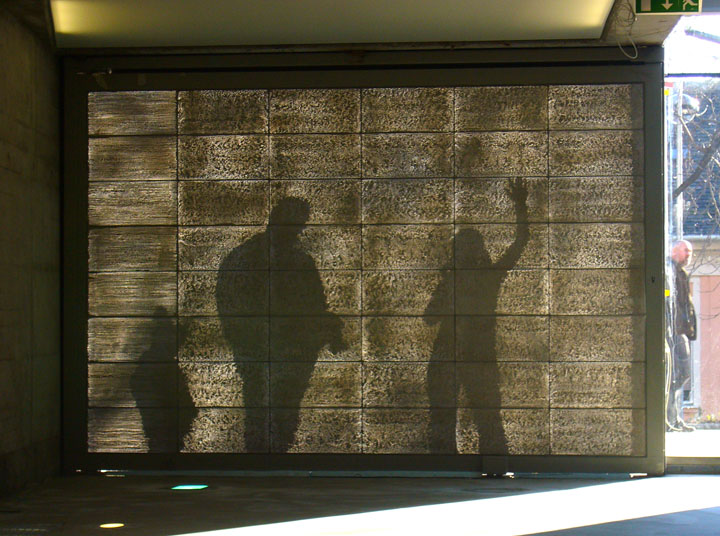
I can see that there is already plenty of regular streetlights in the area, and the way they set up the LiTraCon cubes here is less for illumination and more for decoration. I like the enchanted-runes vibe these cubes give out, it looks like they are inscribed with holy scripture. I like that it's pretty much impossible for external forces to break the lamp inside because they're protected by concrete ( The lamp itself might bust or malfunction though. This was possibly the case with the one cube that was off). But at the end of the day these cubes don't demonstrate my favourite thing about LiTraCon: the way you can cast shadows through it (as sensually presented here).

http://retaildesignblog.net/

When I first saw this material do shadows my intuition speaks shadow puppet theatre. Did I mention LiTraCon also allows colours to shine through? It promises all kinds of exciting visual presentation and connection between both sides of a concrete wall.

From what I've read, LiTraCon cannot (yet!) replace good old concrete because it is way more expensive, so we're not going to see entire concrete structures made of this stuff any time soon. But I'll be very happy to see smart applications of materials like this in cities here and there, infusing the concrete jungle with some visual diversity that any so-called jungle should rightfully include.

--
p.s. originally I wanted to do this blogpost on new technologies and lights, and I was gonn include another location. I tried to visit Daan Roosegaarde's Dune 4.2 interactive installation at Kralingen's De Esch, but the installation was apparently not there any more. I later researched more carefully and found that they removed Dune 4.2 in early 2013. I's been a few years since they set it up (2009) and it makes sense that higher-tech installations don't stay at one location forever.  It's a shame though, I always wanted to see it since it looked hella dope extremely captivating on video.


Sunday, 24 August 2014

Rotterdam Coollection 001

Coollection, a portmanteau, is the collection of cool things. I have coined it just now and the word has a geeky sound to it that I am quite fond of. This is a new kind of posts I'm doing on this blog, where every once in a while I'm going to share a few cool Rotterdam items that I've found on the Internet. Videos, pictures, websites, you name it. Actually I'll name it. Whatever. I'll also put down a few words on why they're cool so you'll have greater insight into my taste in cool things.

--


These guys are doing a project where they travel around the world to shoot rollerblading videos in cities. Sometimes they do tricks. Sometimes they're just fast. They also make cities look very good. In this vid they skate through some of Rotterdam's best-looking places and it's stimulating to see our familiar sceneries re-defined by alternative sets of movements and perspectives. The tracking shots are the best parts. Without rollerblades it would be very difficult to experience these spaces in motion. I mean, sure, you can walk through the Beursplein underground passage, but that's pretty slow.

--


Brett Bogart, now occasionally dubbed the Netherland's Justin Bieber, is a nascent teen-pop sensation from Brabant. He shot this music video for his new single Rooftop on top and around Rotterdam's Schieblock. The video has bright-coloured teen fashion, some cartwheels, several back-flips, and lots of dancing on the rooftop. It's kind of surreal that people born in 1999 are becoming pop stars now. In 10 years' time people born in 2009 are going to be pop stars. Wow. 

snapshot from youtube
Anyways Rooftop is great because while wishing for this video to be an international youtube hit, Brett (and most likely his marketing people) looked for international appeal, and decided on an urban metropolitan feel. Boyz and girlz partying on a rooftop surrounded by sky scrapers, these are colourful kids in a grey city, free and all-so-happy. Naturally they had to film this in Rotterdam because it is the only Dutch city that can pull off this look. After the war, Rotterdam was designed and re-built as the American-styled city of the Netherlands. It had been dubbed accordingly our Manhattan aan de Maas. It is, then, only fitting for the Netherland's JB to shoot his video here.

--


http://ikrotterdam.blogspot.nl/

http://ikrotterdam.blogspot.nl/

ikRotterdam is 3 artists who draw snippets of Rotterdam. They do places, people, objects and whatever else they like. The art is really cool and they make great use of colours to demonstrate that the city doesn't feel so grey after all. The buildings look alive. The human portraits look warm-hearted. They tag each drawing with the area in which its subject matter was seen (Centrum, Delfshaven etc), so you can go and try to find it as well. Their tagline is "I don't need to go on vacation because I live in Rotterdam". It's pretty much how I feel too, but they express it with a charismatic artistic style I wish I had. You can like them on Facebook to get regular updates. I did.